
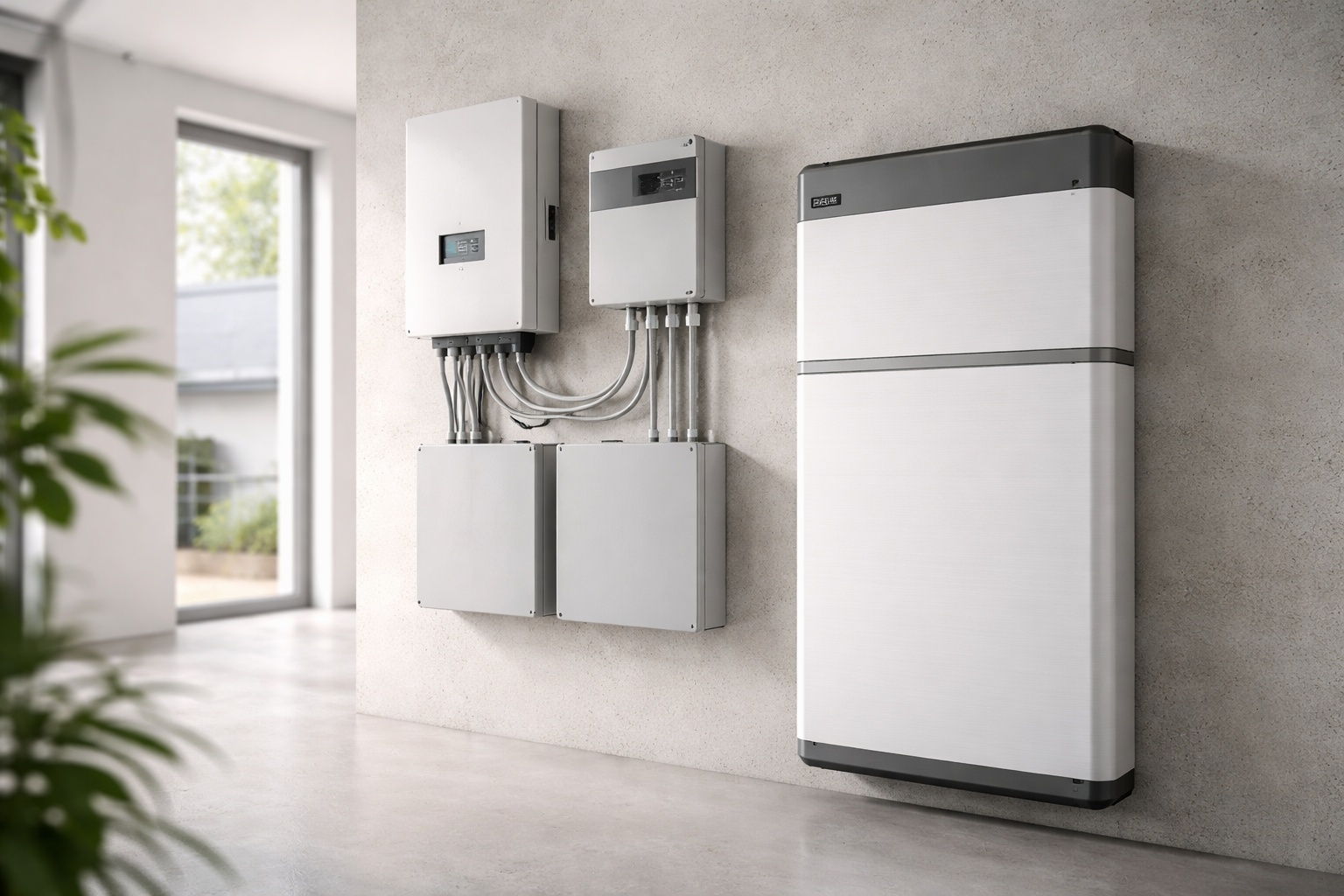
LG Chem RESU is not just a single energy storage system, but a whole family of home ESS batteries, which have been available over the years in several voltage and capacity variants. This is important because, when assessing safety in use, the brand name alone is not enough. One must look at the 48 V models differently, at the high-voltage versions differently, and at older models – which were subsequently subject to service and safety measures – in yet another way.
For this reason, the question of the safety of LG Chem RESU batteries cannot be reduced to a simple “is this a good battery?”. It is necessary to compare the technical specifications with the installation conditions, compatibility with the inverter, the status of the specific model, and the manufacturer’s track record. Only then can one fairly assess whether a given system is safe for everyday use.
What exactly does the RESU family include?
The RESU range included both low-voltage and high-voltage models. On the LG Energy Solution website, under the ‘older solutions’ section, you can see, amongst others, the RESU6.5, RESU10, RESU12, RESU13 and LV 3.3 on the 48 V side, and the 7H Type-R, 7H Type-C, 10H Type-R and 10H Type-C on the HV side. At the same time, some of these models are already marked as superseded, meaning they have been replaced by newer solutions. This shows that the RESU name itself covers several generations of equipment and several different system architectures.
From a safety perspective, this is of great importance. A user who simply says “I have an LG RESU” does not yet provide any specific information about the system voltage, the communication method, the conditions for integration with the inverter, or whether their unit belongs to a group subject to corrective measures. It is precisely these factors that determine the actual level of safety.
Which parameters really matter when it comes to safety?
With ESS batteries, it is easy to focus on capacity, as this is the easiest parameter to compare. In the case of the LG RESU, however, four groups of parameters are more important: voltage architecture, usable energy, the communication interface with the inverter, and the enclosure specifications. LGES’s official websites show, for example, that the RESU13 has a total capacity of 13.1 kWh and a usable capacity of 12.4 kWh, CAN2.0B communication and an IP55 enclosure, whilst the 10H Type-R has a total capacity of 9.8 kWh, a usable capacity of 9.3 kWh, RS485 communication and also an IP55 enclosure. The newer Prime 10H and Prime 16H have 9.6 kWh and 16 kWh of usable capacity respectively, along with RS485 and CAN communication.
This illustrates a simple point: the kWh rating alone does not guarantee that the system will be safe. What matters far more is whether the battery has been correctly integrated with a compatible inverter, whether it is operating in an environment that complies with the manufacturer’s instructions, and whether it is being used in a manner that contravenes the installation guidelines simply because the catalogue specifies an IP55 rating.
| Model | Architecture | Useful energy | Communication | Protection rating |
|---|---|---|---|---|
| RESU13 | 48 V | 12.4 kWh | CAN 2.0B | IP55 |
| 10H Type-R / Type-C | HV | 9.3 kWh | RS485 | IP55 |
| Prime 10H | HV | 9.6 kWh | RS485, CAN | IP55 |
| Prime 16H | HV | 16 kWh | RS485, CAN | IP55 |
The key takeaway from this comparison is simple. Products within the same family may appear similar on the surface, but their system behaviour differs. The 48 V and HV models do not have the same requirements for integration, servicing and risk assessment, even though they are all marketed as home energy storage systems.
48 V and HV – two different systemic risk profiles
48 V models are generally simpler to integrate with low-voltage inverters and fit well into traditional home energy storage systems (ESS). However, their limitation is well known: as power output increases, DC currents rise, and with them the importance of cabling, safety devices, connections and the quality of installation. This is not a shortcoming of any particular brand, but a characteristic of the 48 V architecture itself.
In the HV versions, the system is different. Here, strict compatibility with a specific inverter, correct communication and strict adherence to the installation sequence specified by the manufacturer are of greater importance. High voltage reduces the currents on the DC side, but at the same time places greater demands on the entire system in terms of integration and servicing. From a user safety perspective, this means that 48 V and HV models must be assessed according to different criteria, even though they belong to the same product family.
What do the assembly instructions actually say about safe use?
This is one of the key points of the whole issue. The manuals for the RESU13 and HV models make it very clear that battery safety does not depend solely on the BMS and cell chemistry. The manufacturer permits the installation of certain models both indoors and outdoors, but at the same time prohibits exposing them to direct sunlight and sources of moisture. The manuals also include requirements regarding distance from flammable materials, dust restrictions, the absence of corrosive gases and ambient temperature control, with a range of approximately 15–30°C being specified as optimal.
This means that the term ‘indoor/outdoor’ alone is misleading if taken out of context. A light fitting may have an IP55 rating and still should not be installed in a location that is constantly exposed to direct sunlight or at risk of direct contact with water. In domestic installations, this is one of the most common misinterpretations: the user, or even the installer, treats the IP rating as permission for any environment, whilst the instructions describe the conditions much more narrowly.
IP55 does not mean complete freedom
It is precisely this parameter that is often overlooked. IP55 indicates a specific level of enclosure protection, but does not override the manufacturer’s other requirements. If the manual states that the battery should not be exposed to direct sunlight, moisture or harsh environments, the IP rating alone does not override this. From the point of view of user safety, it is the full set of operating conditions that matters, not just a single figure from the data sheet.
This is particularly important when installing in garages, carports, utility rooms near the boiler room, or on the building’s external walls. Such locations may seem convenient, but they can cause issues with temperature, ventilation, proximity to ignition sources, and environmental resistance. A well-installed wall-mounted unit looks unobtrusive. A poorly chosen location begins to compromise safety before any operational issues become apparent.
Inverter compatibility and communication – an underestimated topic
An ESS battery does not operate in isolation. The safety of the entire system depends on the interaction between the battery, the BMS and the inverter. Therefore, it is not only the voltage and capacity that matter, but also whether a particular RESU model is compatible with the correct inverter, via the correct interface and in accordance with the manufacturer’s current documentation. Models with CAN communication and models with RS485 are not interchangeable in this respect.
If communication is faulty or the configuration has been set up contrary to the manufacturer’s recommendations, the consequences do not necessarily mean an immediate catastrophic failure. They may result in incorrect charge and discharge limits, an incorrect response to an emergency situation, an inaccurate charge level reading, or problems with updates. In battery systems, all of this falls within the scope of operational safety, not just ease of use.
Recalls and safety measures – the most important aspect of the whole issue
This is the crux of the analysis. LG Energy Solution’s official European website contains a clear recall notice regarding certain residential ESS batteries containing cells manufactured before August 2019. The manufacturer explicitly highlights the risk of overheating and fire. This means that, with older RESUs, safety cannot be assessed solely on the basis of whether the system is operating and showing no errors. It is also necessary to check whether the specific unit is subject to safety measures.
The range of models covered by the initiative is extensive. The manufacturer’s announcements mention, amongst others, the RESU3.3, RESU6.5, RESU10, RESU13, RESU7H Type-R, RESU7H Type-C, RESU10H Type-R, RESU10H Type-C and RESU10M. This means that the issue does not concern a single niche model, but a large part of the classic RESU family.
The manufacturer has provided for two courses of action. For some batteries, a free replacement was required, and it was stated that these units should remain switched off until they are replaced or removed. For others, a diagnostic software update was provided, designed to detect units at risk of overheating and switch them off as a safety measure. This distinction is very important, because without checking the status of a specific battery, it is impossible to safely determine whether it should be switched off or, conversely, left online for the update.
| What you need to check | Why is this important? |
|---|---|
| Exact battery model | different models were subject to different measures |
| Serial number | only this allows the status of a specific item to be determined |
| Cell production period | The recall related to specific production periods |
| Status: recall / corrective action | this determines how we proceed |
| Does the battery need replacing or does it need a software update? | these two scenarios lead to different practical decisions |
The most important point to take away from this table is simple. Ensuring the safety of an older RESU unit starts with identifying the specific unit itself. It does not depend on the unit’s appearance, the installer’s recollection, or the general model name. Only the serial number and the status on the manufacturer’s website allow us to move from mere speculation to a realistic risk assessment.
What does a recall mean for the owner of the installation?
Firstly, you need to check the serial number and status of the battery on the official recall website. Secondly, you must not dismantle the battery yourself or disconnect the cables just to ‘get a better look at the label’. This is all the more important if the manufacturer does not recommend doing so. Thirdly, if the battery belongs to a group requiring replacement, you must follow the manufacturer’s instructions and not assume that, just because the system is working, there is no problem.
This is not a historical issue. LGES’s official websites still maintain separate sections for recalls and corrective actions, and the manufacturer’s statements and CPSC notifications show that the fire risk was taken very seriously. That is precisely why, with the LG Chem RESU, the service history and the unit’s condition are just as important today as the product specification sheet.
Where are mistakes most commonly made?
The most common mistake is treating the entire RESU range as a single product. The second is assuming that IP55 rating guarantees complete resistance to all outdoor conditions. The third is failing to check for recalls on older models. The fourth is assuming that, simply because the inverter ‘detects the battery’, the integration is correct and safe. The fifth is to overlook installation conditions, particularly temperature, ventilation and distance from flammable materials.
These are all errors that do not necessarily lead to an immediate failure. Often, nothing happens for a long time, and that is precisely what lulls people into a false sense of security. The problem is that the safety of ESS systems is not usually compromised by a single spectacular error, but by a combination of oversimplifications: poor installation, failure to verify the serial number, poor compatibility with the inverter, and misinterpretation of catalogue parameters.
Specifications and safety – what the technical data really tells us
The product data sheet tells you a lot, but not everything. It shows the usable capacity, voltage architecture, communication protocols, protection class and basic range of applications. However, it does not automatically tell you whether a particular battery is subject to a recall, whether it has been installed correctly, whether it is working with the correct inverter, or whether it is being used in accordance with the manufacturer’s specifications.
Therefore, the safety of using RESU does not depend on a single parameter. It depends on how the technical data is interpreted in the context of actual operating conditions. Two units with the same capacity and the same IP rating may have completely different safety profiles if one is a newer model that has been installed correctly, whilst the other is an older unit that has undergone maintenance and is installed in an unsuitable environment.
Is LG Chem RESU a safe choice today?
Yes, but only under certain conditions. Provided the model has been correctly identified, is not subject to an outstanding recall, is compatible with a suitable inverter, and has been installed strictly in accordance with the manufacturer’s instructions, the RESU can be a safe home energy storage solution. However, if the user does not know exactly which model they have, has not checked the serial number and assumes that every LG battery ‘is definitely fine’, then such an assessment is worthless.
The most honest answer, therefore, is that the safety of LG Chem RESU batteries does not depend solely on the brand or the capacity. It depends on the specific unit, its history and its operating conditions. That is precisely why, with this product range, the serial number and the manufacturer’s service history are just as important today as the technical specifications.
Summary
LG Chem RESU is a family of batteries, not a single product, so when discussing safety, it is essential to start by identifying the exact model. The 48 V and HV versions differ in terms of system architecture, integration with the inverter, and practical design requirements. Specifications such as usable energy and IP55 provide important information, but are not sufficient for a comprehensive safety assessment.
The key point of this whole issue is the recall and corrective measures for some older batteries. It is precisely these factors that demonstrate that, with RESU, safety cannot be assessed solely on the basis of day-to-day monitoring of the system’s operation. One must know the model, serial number, recall status and installation conditions. Only then can one speak of genuine safety in use, rather than merely a specification that sounds good on paper.
Sources:
https://www.lgessbattery.com/m/eu/main/main.lg
https://seasolargroup.com/wp-content/uploads/2018/12/lg-chem-resu13-install.pdf
https://recall.lgessbattery.com/eu/recallnotice.html
https://www.cpsc.gov/Recalls/2021/LG-Energy-Solution-Michigan-Recalls-Home-Energy-Storage-Batteries-Due-to-Fire-Hazard-0