
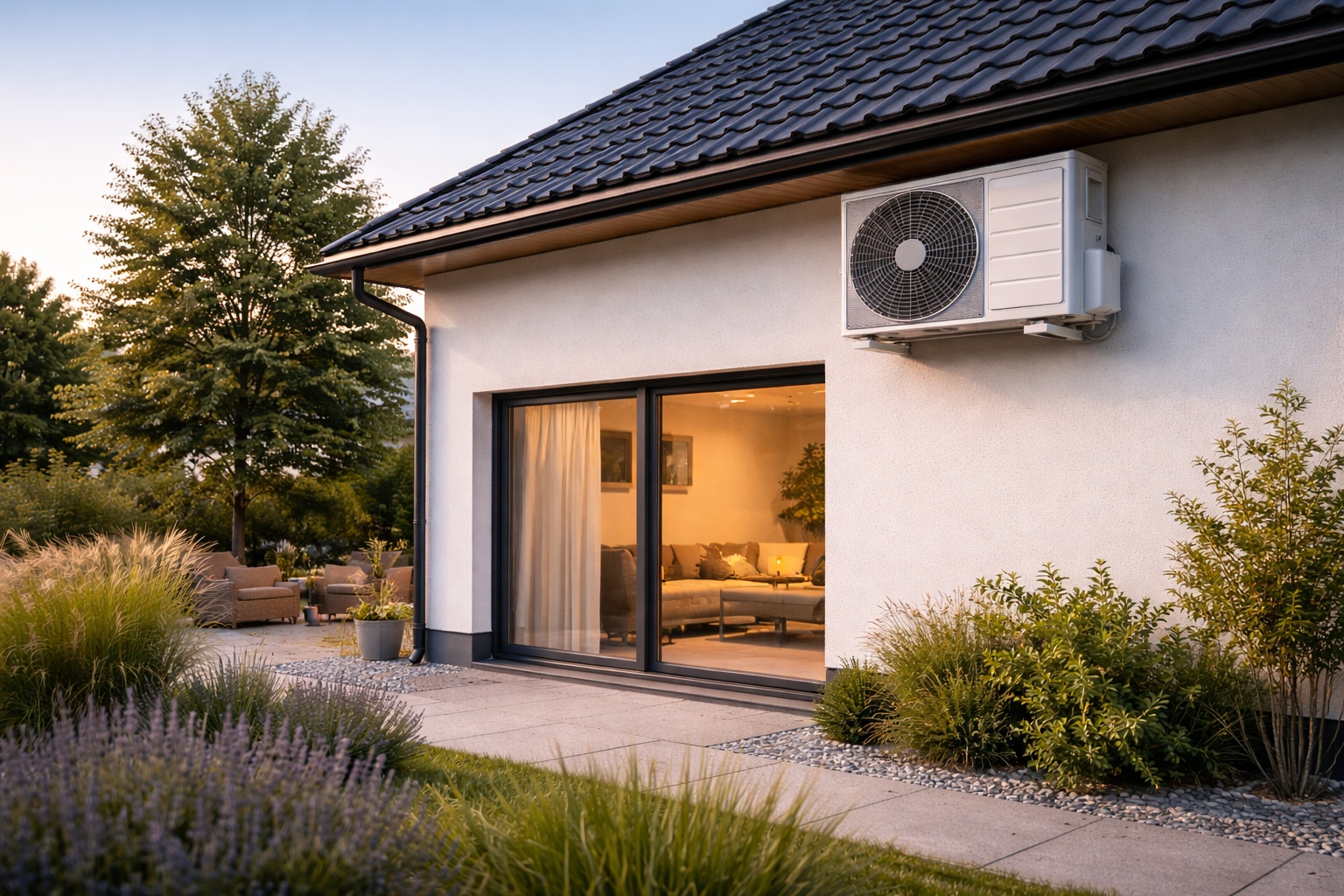
There is no single general rule in the UK that says, “an outdoor air conditioning unit may have a maximum of X dB.” What matters in practice is not the product name, but the actual noise impact at the site, the type of premises affected, and the legal route used to assess it. For an outdoor condensing unit, that usually means a mix of planning control, acoustic assessment, and, if complaints arise, statutory nuisance law.
The second important point is that three different things need to be separated, because they are often confused. The first is statutory nuisance. The second is the acoustic performance of the building and indoor spaces. The third is the manufacturer’s published sound data, usually sound power level or sound pressure level. These are not the same figures, and they cannot be compared one-to-one.
What is actually checked for an outdoor air conditioning unit?
For an outdoor unit, the key questions are usually these. First: does the installation need planning permission, or can it rely on permitted development rights. Second: will the unit create an unacceptable noise impact at the nearest noise-sensitive premises. Third: could the way it operates amount to a statutory nuisance in the real conditions of the site.
That is why it is usually wrong to say, “the unit is 56 dB in the brochure, so it is unlawful,” or, on the other hand, “it is 45 dB, so it must be compliant.” In practice, acceptability is judged through the effect of the installed unit in context, not from one catalog number read in isolation.
What actually acts as the reference point?
For outdoor air conditioning units, there is no single nationwide table that works like a universal “day limit” and “night limit” for every site. Different frameworks are used depending on the case.
| Assessment route | What is checked | What it means in practice |
|---|---|---|
| Statutory nuisance | Noise level, duration, frequency, time of day or night, and the character of the locality | There is no single universal dB limit for every outdoor unit |
| Planning / fixed plant assessment | Usually the effect of plant noise at the nearest noise-sensitive premises, often using BS 4142 | The outcome is site-specific and may be tied to planning conditions rather than one national number |
| Domestic air source heat pump route in England | MCS 020 sound calculation for permitted development | This is not a general rule for all air conditioners and does not apply to units used solely for cooling |
| Indoor acoustic performance | Noise inside the building and the effect of the installation on habitable rooms | This is a separate issue from outdoor nuisance or planning compliance |
This matters because it shows the real structure of the issue. An outdoor air conditioning unit is not judged against one magic dB figure. It is judged through the legal and acoustic framework that fits the site, the use, and the type of development.
How should “day” and “night” be understood in practice?
There is no single table that applies to every outdoor condensing unit, but the time of operation still matters a great deal. When councils assess possible nuisance, they look at the noise level, how long it lasts, how often it occurs, and whether it happens during more sensitive periods such as late evening or night. In practice, night-time operation is usually harder to justify because that is when disturbance to rest and sleep becomes more important.
The same logic appears in planning and acoustic reports. If a unit runs only during the day, the assessment should reflect daytime operation. If it runs at night, night-time impact becomes critical. If it runs continuously, both periods need to be considered. So the real question is not just “how loud is it,” but also “when, how often, and in what setting does it operate.”
The data sheet figure is not the legal limit
Manufacturers usually publish the sound power level or the sound pressure level under defined test conditions. That is a product parameter, and it is useful for comparing models. It is not, by itself, the legal test for whether an installed unit is acceptable.
This distinction is essential. In the real world, the outcome depends on distance, screening, reflections from walls, mounting height, brackets, structure-borne vibration, background sound, hours of use, and the position of neighbouring windows or bedrooms. A relatively quiet unit can still become a problem if it is badly positioned, while a nominally louder unit may be acceptable if the siting and mitigation are handled properly.
Outdoor nuisance is one thing, indoor noise is another
Even where an outdoor unit does not create a clear nuisance issue outside, there may still be a problem inside the building. That usually happens where the unit is mounted on a façade, balcony, roof, or brackets fixed to a structure adjoining a habitable room. In those situations, the issue is not only airborne noise, but also structure-borne vibration.
That is why a unit can look acceptable on paper and still create a real comfort problem once installed. A correct assessment should always separate the outdoor impact from the effect on the building itself.
Is there a minimum distance from the property boundary?
There is no single nationwide rule saying that every outdoor air conditioning unit must be installed exactly 2, 3, or 4 metres from the boundary. The dominant logic is not a universal spacing rule, but the real effect of the installation: visual impact, amenity, planning status, and noise impact at nearby noise-sensitive premises.
In practice, that means the following factors matter most: the installation position, distance from windows, screening, mounting height, vibration isolation, and the direction of the fan discharge. Two identical units can produce a very different result simply because one is placed freely near ground level while the other is suspended in a reflective corner between walls.
How is this kind of noise assessed formally?
If the issue moves onto a formal footing, phone apps and casual readings are not enough. For commercial plant, fixed installations, and many planning cases, the standard reference method is BS 4142, which is used to assess industrial and commercial sound at residential premises. The focus is not on one product number, but on the specific sound from the plant in its actual context.
There is an important nuance here. BS 4142 is commonly used for planning and fixed-plant impact, but it is not itself the legal test for statutory nuisance. Statutory nuisance is decided under the Environmental Protection Act 1990 and depends on the real effect of the noise on health or on the use and enjoyment of premises. So the formal route depends on whether the case is mainly about planning, enforcement, or nuisance.
What usually matters most in practice?
The safest approach is simple: do not choose an outdoor unit based only on cooling or heating output. Acoustic performance and installation geometry need to be considered from the start. A good model can still fail acoustically if it is fixed under a bedroom window, boxed into a reflective recess, or mounted on brackets that transfer vibration into the structure.
In real projects, the biggest problems usually come not from the very largest units, but from poor siting. A condenser in a narrow side passage, in a corner between walls, or directly outside a quiet room can become far more intrusive than the brochure suggests. At that point, the issue is no longer just the manufacturer’s dB figure. It is the whole installation, including reflections, tonal character, mounting, and hours of use.
The shortest answer
If the question is whether there is one universal legal noise limit in the UK for every outdoor air conditioning unit, the short answer is no. In practice, the key tests are whether the installation creates a statutory nuisance, whether it complies with planning requirements or planning conditions, and whether the plant would pass the kind of fixed-plant acoustic assessment normally used for the site.
One final distinction matters as well. The current MCS 020 route in England uses 37 dB LAeq,5min at the assessment position for domestic air source heat pumps under permitted development, but that is not a general rule for all outdoor condensers and it does not apply where the unit is used solely for cooling. So a proper assessment should always separate three things: planning status, nuisance risk, and the device’s own catalog parameters.
Sources
Environmental Protection Act 1990, section 79:
https://www.legislation.gov.uk/ukpga/1990/43/section/79
Method implementation document for BS 4142, GOV.UK:
https://www.gov.uk/government/publications/method-implementation-document-mid-for-bs-4142/method-implementation-document-mid-for-bs-4142
Planning Permission: Air source heat pump, Planning Portal:
https://www.planningportal.co.uk/permission/common-projects/heat-pumps/planning-permission-air-source-heat-pump/