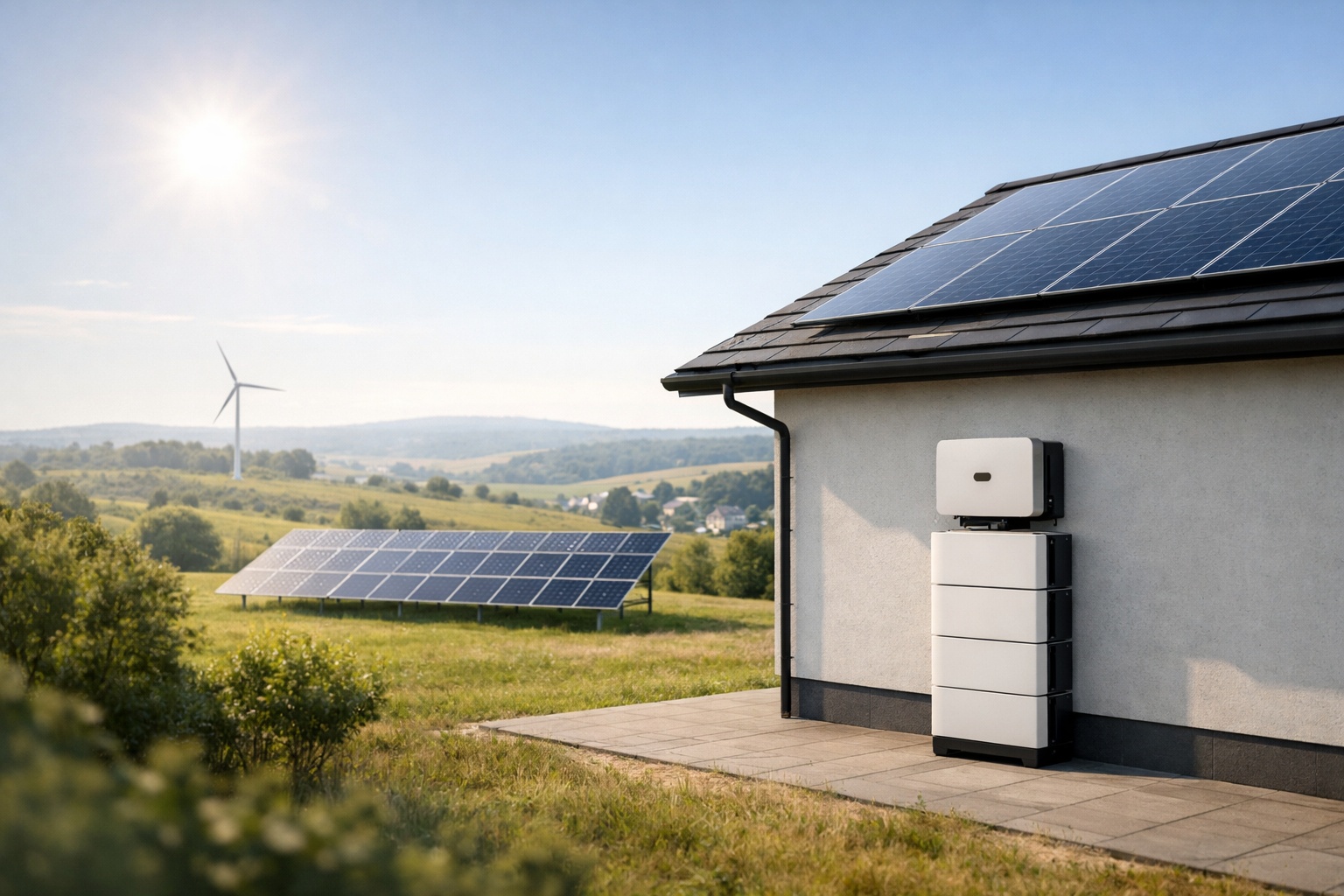
Huawei LUNA2000 is a modular battery storage system designed to work with Huawei SUN2000 inverters. The main advantage of this system is not just its capacity, but the way it is built. It can be installed in a smaller configuration first and expanded later without replacing the whole battery. That is exactly why LUNA2000 is often chosen for installations that are expected to grow with the property’s energy use, changes in electricity demand, or later expansion of the solar PV system.
There are currently two main product families in this range. The older line is LUNA2000-5/10/15-S0. The newer one is LUNA2000-5/7/10/12/14/15/17/19/21-S1. Both use LFP chemistry, meaning lithium iron phosphate cells, but they differ in architecture, available capacity options, and maximum operating power. This is not a cosmetic change. In practice, the S1 series offers much greater flexibility.
How is the Huawei LUNA2000 system built?
LUNA2000 is not a single battery in the traditional sense. The system consists of a control unit and battery modules. In the S0 series, the control unit is the LUNA2000-5KW-C0 and the battery module is the LUNA2000-5-E0 with a 5 kWh capacity. In the S1 series, Huawei uses the LUNA2000-10KW-C1 control unit together with LUNA2000-5-E1 and LUNA2000-7-E1 battery modules. The latter, despite the simplified “7” label, provides 6.9 kWh of usable energy according to the manufacturer’s documentation.
This matters because the buyer is not simply purchasing “a 10 kWh battery,” but a specific system with a defined number of modules, operating voltage, and power limit. Each extra module increases the available capacity, but the system still operates as one battery string managed by the BMS and integrated with the inverter.
Technical specifications of the S0 and S1 series
The most important parameters are easiest to understand side by side.
| Parameter | LUNA2000 S0 | LUNA2000 S1 |
|---|---|---|
| Cell chemistry | LFP (LiFePO4) | LFP (LiFePO4) |
| Control unit | LUNA2000-5KW-C0 | LUNA2000-10KW-C1 |
| Single module capacity | 5 kWh | 5 kWh or 6.9 kWh |
| Number of battery modules per stack | 1–3 | 1–3 |
| Capacity range of one stack | 5 / 10 / 15 kWh | 5.0–20.7 kWh |
| Maximum charging and discharging power | up to 5 kW | up to 10.5 kW |
| Operating voltage in a single-phase system | 350–560 V | 350–560 V |
| Operating voltage in a three-phase system | 600–980 V | 600–980 V |
| Ingress protection rating | IP66 | IP66 |
| Operating temperature | -20°C to +55°C | -20°C to +55°C |
| Cooling | natural convection | natural convection |
The table already shows that S1 is not simply a refreshed version of the older product. It is a system with broader capacity options and clearly higher operating power. That second point matters when choosing a battery, because the kWh figure alone does not tell you how quickly the system can absorb excess solar generation or discharge energy back into the property.
What capacities can be built?
In the S0 series, the configuration is very straightforward. At stack level, there are three standard options: 5 kWh, 10 kWh, and 15 kWh. The system is built by adding one, two, or three 5 kWh battery modules to the control unit.
In the S1 series, the situation is different. The 5 kWh and 6.9 kWh modules can be combined, which makes the configuration range much wider. For a single stack, Huawei provides several usable capacity options.
| Module configuration | Usable capacity |
|---|---|
| 1 × 5 kWh | 5.0 kWh |
| 1 × 6.9 kWh | 6.9 kWh |
| 2 × 5 kWh | 10.0 kWh |
| 5 + 6.9 kWh | 11.9 kWh |
| 2 × 6.9 kWh | 13.8 kWh |
| 3 × 5 kWh | 15.0 kWh |
| 5 + 5 + 6.9 kWh | 16.9 kWh |
| 5 + 6.9 + 6.9 kWh | 18.8 kWh |
| 3 × 6.9 kWh | 20.7 kWh |
This is where the newer version clearly stands out. In the S0 series, the buyer is limited to three fixed capacity steps at stack level. In the S1 series, the battery can be matched much more precisely to the property’s consumption profile. That is especially useful where the system is expected to be expanded in phases.
Expansion options after installation
From the user’s point of view, one of the most important strengths of LUNA2000 is the option to expand it later. In the S0 series, this means adding further 5 kWh modules to the existing stack, up to 15 kWh per stack. In practice, that means you can start at 5 kWh and move later to 10 or 15 kWh without replacing the whole system.
In the S1 series, the flexibility is greater. You can not only add another module, but also build mixed configurations using 5 kWh and 6.9 kWh segments. That means the owner does not need to buy the maximum capacity from the outset. It is possible to start with a smaller setup and expand the battery later if self-consumption rises, an EV charger is added, or the way the property is used changes.
That is exactly why this system fits well with a staged investment approach. It does not force oversizing at the start, but it also does not block future expansion.
How many battery systems can be connected to one inverter?
This is one of the points where a lot of simplified descriptions appear. In older summaries, the system is often presented as one inverter plus one battery stack. That does not always reflect the full capability of the range.
For the S0 series, a single stack covers 5 to 15 kWh, but the official specifications also allow up to two systems in parallel operation, which means up to 30 kWh where the compatible inverter and system layout allow it. In the S1 series, one group can reach 20.7 kWh, and for selected SUN2000-12/15/17/20/25K-MB0 inverters Huawei allows up to four ESS systems in parallel. That means a maximum of 82.8 kWh on one inverter.
That is already beyond a typical domestic battery setup. A configuration like this can make sense in larger homes, properties with high self-consumption, or lighter commercial applications where the battery is expected to do more than just cover evening household loads.
Charging and discharging power
Capacity shows how much energy can be stored. Power is a separate matter and determines how quickly the battery can charge and discharge. This is a very important parameter, but it is often overlooked in simple comparisons.
In the S0 series, charging and discharging power goes up to 5 kW. In the S1 series, Huawei states up to 10.5 kW. That is a significant difference. It means the newer version is better suited to installations where the battery is expected to absorb solar surplus quickly or support larger loads with fewer power constraints.
When choosing a system, it is therefore not enough to ask only about the number of kWh. You also need to check whether the battery’s power rating matches the property’s load profile and the operating pattern of the solar PV system.
Compatibility with Huawei inverters
LUNA2000 works within the Huawei ecosystem. That is one of its strengths, but also one of its limits. The system makes the most sense where the whole installation is built around SUN2000 inverters and the FusionSolar platform.
For the S0 series, Huawei lists compatibility with models such as the SUN2000 L1 and M1 ranges. In the case of the S1 series, the list is broader and also includes selected inverters from the SUN2000-MB0 family, as well as certain other compatible models depending on the market and product generation. That matters not only for a new installation, but also for future expansion. It is not enough to know that “it is Huawei”. The exact inverter model, the battery generation, and the permitted storage configuration all need to be checked.
Cell chemistry and safety
Both series are based on LFP cells, meaning lithium iron phosphate. This is now one of the most widely used chemistries for stationary battery storage. The reason is simple: good cycle durability, strong thermal stability, and a favourable safety profile compared with some other lithium-ion chemistries.
Huawei also highlights the cobalt-free chemistry. That is not just a marketing line. In stationary storage systems, this chemistry profile genuinely makes sense. The issue is not only service life, but also the predictability of system behaviour over many years of operation.
Of course, chemistry alone does not decide everything. Battery safety also depends on the BMS, installation quality, cooling method, control electronics, and the architecture of the whole system. Even so, the choice of LFP fits well with how modern battery storage is now designed for use alongside solar PV.
Certificates and standards
Huawei’s documentation for LUNA2000 includes standards and procedures typical of mature battery storage systems. These include IEC 62619 and UN 38.3, among others. For the end user, that means this is not a random set of modules, but a product designed around specific requirements for safety, transport, and long-term operation.
That matters especially when the battery is expected to operate for many years, support backup power, or form part of a larger energy investment. In those cases, documentation and certification matter just as much as the nominal capacity.
Ingress protection, operating conditions, and installation
Huawei specifies an IP66 rating for these battery systems. That is a high enclosure protection rating and an important advantage where installation conditions are not ideal. The system is also designed to operate from -20°C to +55°C and uses natural convection cooling.
That still does not mean the installation position no longer matters. A battery storage system should still be placed where it will not be overheated, flooded, or exposed to unnecessary environmental stress. With battery equipment, a high ingress rating is a real advantage, but it does not replace a sound installation design.
Is Huawei LUNA2000 suitable for backup power?
Yes, but this point needs to be understood properly. The battery itself is not yet a complete backup system. Backup capability depends on the full setup, including the inverter, switching equipment, and the logic of the overall system.
In practice, Huawei provides solutions such as Smart Guard or Backup Box, depending on the system generation and the inverter used. This matters because many users assume that every battery automatically behaves like a UPS for the whole home. It does not. From the outset, the design has to define which circuits are backed up, how much power the system must provide, and how it should operate during a mains outage.
Key strengths of the system
From a technical point of view, the main strengths of LUNA2000 are quite clear. They are modular expansion, the use of LFP chemistry, good integration with Huawei inverters, the high enclosure protection rating, and the greater flexibility of the newer S1 series. Another important strength is the consistency of the whole ecosystem. In practice, monitoring, control, and battery operating logic are tightly integrated with the FusionSolar platform.
That is what makes the system work especially well where the owner wants a tidy PV-and-battery setup rather than a mixed installation made up of many brands and compromises at the integration level.
Limitations worth keeping in mind
This is not the ideal solution for every scenario. The most important limitation is that LUNA2000 makes the strongest case for itself inside the Huawei ecosystem. If someone wants complete freedom to mix components from different brands, this route may be less convenient.
The second point is that expandability does not remove the need for planning. You still need to know which inverter will be paired with the battery, what final capacity is likely to be needed, and whether the chosen model will support future expansion. With systems like this, it makes sense to think a few steps ahead rather than look only at the starting price.
The third point is more technical. In the newer series, it is easy to reduce the whole subject to the phrase “a 21 kWh battery”. Formally, though, what we are talking about is a combination of modules and a control unit delivering up to 20.7 kWh of usable energy in one group. The numerical difference is small, but it matters if someone is comparing systems closely.
Conclusion
Huawei LUNA2000 is one of the more mature battery storage systems in the residential and light commercial segment. Its biggest advantage is not just the headline capacity, but the combination of several strengths: modular construction, LFP chemistry, a high protection rating, good integration with SUN2000 inverters, and a genuine ability to expand over time.
If the priority is a system that can be developed in stages and built around one consistent PV ecosystem, LUNA2000 is a very strong candidate. If, however, the goal is maximum freedom to mix different brands or build a more open architecture, compatibility and the future expansion route need to be checked carefully before purchase.
Sources
Huawei, official LUNA2000-5/10/15-S0 specs page:
https://solar.huawei.com/en/products/luna2000-5-10-15-s0/specs/
Huawei, official SUN2000 single-phase inverter specs:
https://solar.huawei.com/en/products/sun2000-3-4-5-6ktl-l1/specs/
Huawei, official SUN2000 three-phase inverter specs:
https://solar.huawei.com/en/products/sun2000-3-4-5-6-8-10ktl-m1/specs/