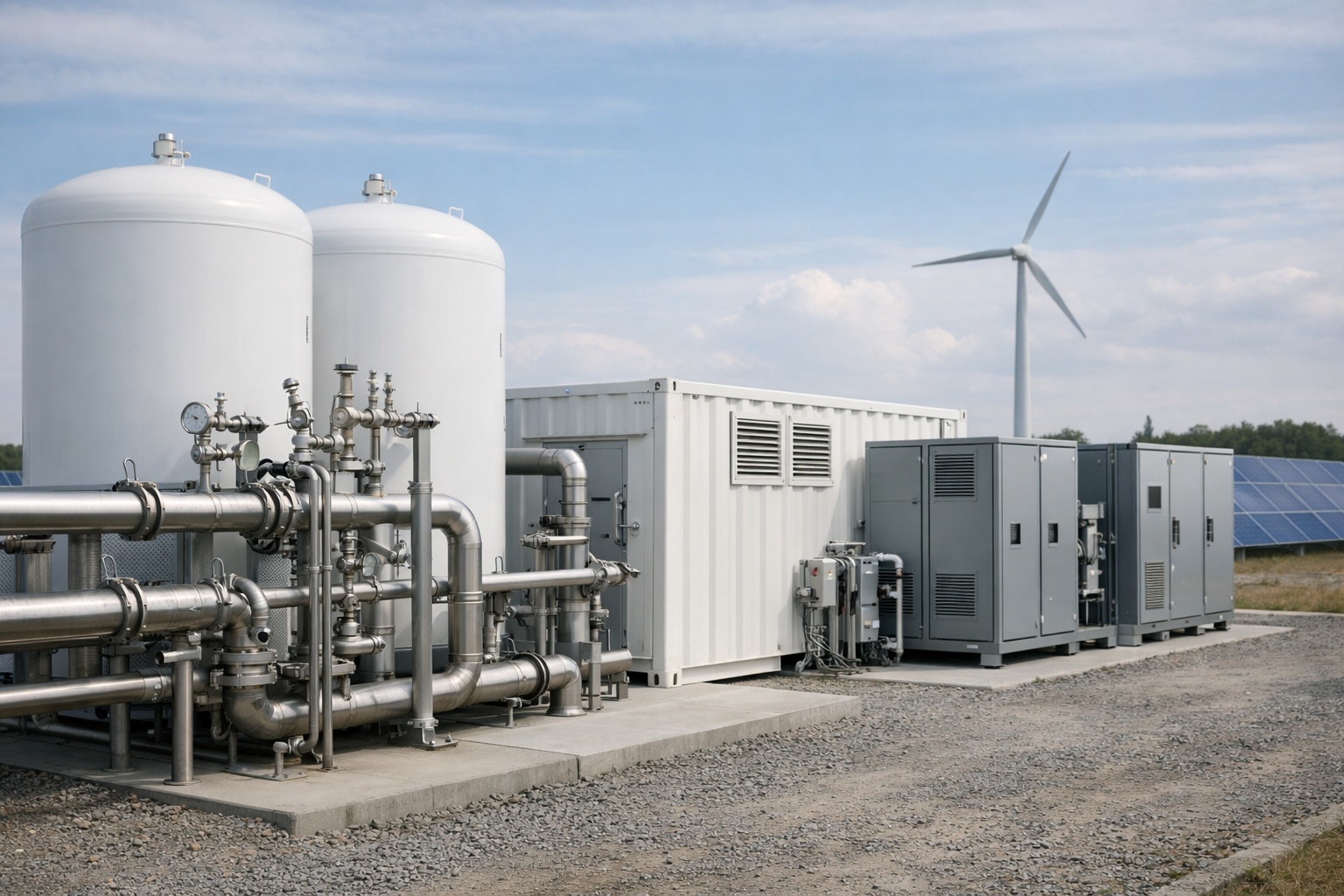
A hydrogen energy storage system does not store electrical energy directly. It first converts electricity into hydrogen, then stores that hydrogen, and finally recovers the energy from it as electricity or uses it in another way, for example as a fuel or feedstock. That immediately sets it apart from batteries. A battery is faster and more efficient in a short cycle, while hydrogen is more complex at the system level but offers greater flexibility for long-duration storage and larger-scale applications.
The importance of this technology is growing along with the expansion of solar and wind power. When the energy system needs not only to shift energy from midday to the evening, but also to hold it for many hours, days, or even seasonally, chemical storage becomes a real alternative to conventional batteries. This is exactly where hydrogen becomes interesting: not because it is the most efficient option, but because it offers a different scale and a different logic for using energy.
How does it work?
The entire system works as a conversion chain. When excess electricity becomes available, it is sent to an electrolyzer. The electrolyzer splits water into hydrogen and oxygen. In this way, the energy is effectively “locked” into a chemical fuel. The hydrogen is then stored, and when the system needs energy again, it returns to the cycle through a fuel cell or another power generation unit. Only at that stage does the chemical energy become electrical energy again.
This matters because each stage has its own limitations. The electrolyzer needs energy and suitable operating conditions. Hydrogen storage requires pressure, temperature control, or an appropriate storage medium. The part of the system that recovers the energy has its own efficiency, dynamics, and auxiliary requirements. As a result, what is being evaluated is not a single device, but the entire system. That is where the difference begins between a simple narrative about “green hydrogen” and a real energy project.
| System component | Main function | What limits the project |
|---|---|---|
| Electrolyzer | conversion of electricity into hydrogen | cost, efficiency, operating dynamics, energy availability |
| Hydrogen storage | storing energy in chemical form | pressure, volume, temperature, safety |
| Fuel cell or other recovery unit | conversion of hydrogen back into usable energy | efficiency, cost, unit output |
| Control and conversion system | integration of the entire system with the load or the grid | operational complexity and auxiliary losses |
This table organizes the topic well for one reason: it shows that a hydrogen storage system is not just a “tank full of energy,” but a combination of several technologies that have to be matched properly. If even one component is oversized or undersized, the entire system starts to perform worse than its storage capacity alone would suggest.
Where is hydrogen stored?
The simplest and best-known option is compressed hydrogen in pressure vessels. For gaseous hydrogen, typical high-pressure tanks operate in the range of 350 to 700 bar. This is a mature and well-understood solution, but it has a volumetric limitation. Hydrogen has very low density under ambient conditions, so without compression or liquefaction it takes up a great deal of space.
The second route is liquid hydrogen. Here, storage density increases, but an entire layer of cryogenic challenges appears. Hydrogen boils at about −252.8°C at atmospheric pressure. That means greater technical complexity, higher material requirements, and additional energy costs for the liquefaction process itself. So this type of storage is not simply a “better tank,” but a separate class of infrastructure.
The third path is storage in solid materials through adsorption or absorption. This direction is technologically important, but for larger-scale energy storage, the discussion much more often centers on compressed gas, liquid hydrogen, or geologic storage. That last group is especially interesting from a system perspective. In Europe, pure hydrogen has already been stored in salt caverns for decades, and new projects are also advancing approaches involving depleted reservoirs and aquifers. This is where hydrogen moves beyond the scale of a single facility and becomes part of energy infrastructure.
The biggest issue: overall cycle efficiency
This is the main technical weakness of hydrogen energy storage. Losses occur during electrolysis, storage, compression or liquefaction, and then again during energy recovery. For a system consisting of electrolysis, hydrogen storage, and a fuel cell, typical round-trip efficiency is around 40%, while lithium-ion batteries usually fall within the 70% to 90% range. That is a fundamental difference, not a minor catalog detail.
This becomes even clearer in the performance of real systems. For the ARIES platform, round-trip efficiency was reported at about 28.3% at full power and about 35.1% under a more favorable partial-load scenario for a specific AC-to-AC configuration, including auxiliary loads and system losses. That illustrates the point well: in a real installation, what operates is not “the best device efficiencies on paper,” but the whole system with fans, pumps, cooling, power conversion, and controls.
This leads to a very simple conclusion: if the goal is only to shift energy from midday to evening or smooth the daily output profile of solar generation, hydrogen will usually lose to a battery. It becomes attractive only when the storage system is meant to operate for long durations and efficiency is not the only economic criterion.
Hydrogen energy storage versus batteries
These are not technologies that can honestly be compared in a single sentence. A battery is better for fast balancing, frequent charge-discharge cycling, and shorter storage durations. Hydrogen is far weaker in terms of efficiency, but it offers a different storage scale and can operate on a multi-hour, multi-day, or seasonal basis. In addition, it can be used not only to generate electricity, but also in transportation, heat, or industrial processes.
| Comparison area | Hydrogen storage | Li-ion battery |
|---|---|---|
| Storage method | chemical energy carrier | electrochemical storage |
| Cycle efficiency | significantly lower | significantly higher |
| Storage duration | from hours to months | usually from minutes to several hours, less often longer |
| Typical use case | long-duration storage, backup, sector coupling with H2 | daily balancing, fast regulation, local storage systems |
| Value beyond the power sector | high | low |
| Infrastructure complexity | high | lower |
The key point is that hydrogen does not make sense as a “worse battery,” but as a different tool for a different problem. When a project requires multi-day autonomy, seasonal operation, or simultaneous use of hydrogen beyond power generation itself, that is where its real application begins.
Where does hydrogen make the most sense?
Balancing the power system
This is one of the most logical scenarios. Excess electricity from solar and wind is sent to an electrolyzer, the hydrogen is stored for a longer period, and then it returns as energy when the system needs it. Seasonal storage can reduce renewable curtailment, lower the need for peaking capacity, and change how the entire system operates when the share of renewables becomes very high.
This is exactly where hydrogen shows its advantage over batteries. Not in speed or efficiency, but in its ability to hold large amounts of energy for longer periods without the cost of storage capacity rising as sharply as it does in conventional battery systems. For very long storage durations, hydrogen can begin to compete on cost with batteries despite lower efficiency, because the cost structure of power and energy is distributed differently.
Microgrids and islanded systems
In microgrids, hydrogen makes sense primarily as part of a hybrid system. Not as the only storage medium, but as a long-duration buffer alongside batteries and renewables. The battery handles rapid changes, stabilization, and daily cycling, while hydrogen provides a deeper energy reserve for longer periods without generation. This kind of setup handles weather variability better and provides greater autonomy than a short-duration storage system alone.
Microgrid studies also show something important: a poorly sized hydrogen system can provide far less resilience than expected if there is not enough energy available to produce H2 and if the storage capacity is not large enough. That is a good example of the fact that hydrogen does not work “by itself”; it requires a very deliberate calculation of the entire microgrid architecture.
Backup power for critical facilities
A very interesting direction involves facilities that require many hours or many days of backup power, especially data centers and critical infrastructure. Megawatt-scale fuel-cell systems are being developed for data center backup, with targets reaching as much as 48 hours of liquid hydrogen storage. That shows two important things. First, hydrogen can enter spaces where conventional diesel becomes problematic from both an environmental and operational standpoint. Second, it is still an expensive solution that requires space, cooling, process safety, and access to hydrogen.
Industry and sector coupling
This is probably the strongest argument in favor of hydrogen. An H2-based energy storage system does not have to end its role by sending electricity back to the grid. Hydrogen can be used as a process fuel, an industrial feedstock, an energy carrier for transportation, or a component of a broader facility energy system. In this way, energy storage stops being just storage and becomes part of a multi-sector infrastructure.
| Scenario | Does hydrogen make sense? | Why |
|---|---|---|
| Daily storage for a home with solar PV | generally no | too inefficient and too complex compared with a battery |
| Multi-day storage for renewables | yes | storage duration and energy scale matter most |
| Backup power for a data center | yes, but selectively | high autonomy and a low local emissions footprint, but high cost and complexity |
| Industrial microgrid | yes, preferably in a hybrid setup | battery for short buffering, hydrogen for long autonomy |
| Small business with self-consumption | usually no | a battery is simpler and more cost-effective |
| Facility that also uses hydrogen as a process input | very much so | one energy carrier serves several functions at once |
This table draws the boundary well. Hydrogen is not the answer to every energy storage question. It is the answer to those questions where duration, scale, and multifunctional use of the energy carrier are what matter most. In those cases, its efficiency disadvantage stops being the only criterion that matters.
Technical limitations that cannot be ignored
The first limitation is efficiency, but not the only one. The second is the cost of the entire system. A hydrogen storage system does not consist of a “hydrogen battery,” because such a thing simply does not exist. What has to be accounted for is the electrolyzer, the tank or geologic storage, compression or liquefaction, the energy recovery unit, power conversion equipment, cooling, automation, and process safety. This is infrastructure, not a single device.
The third limitation is volumetric density. Hydrogen has very high specific energy per kilogram, but without compression or liquefaction it has low volumetric energy density. That means greater requirements in terms of space, pressure, temperature, and materials. In practical design terms, that translates into a completely different logistics model than what is used for a battery energy storage container.
The fourth limitation is safety and operation. This is not about creating sensationalism around hydrogen, but about honestly recognizing that such a system requires leak detection, ventilation, procedures, hazard analysis, and well-designed infrastructure. In demonstration projects, this area is treated as an integral part of the system, not as an add-on at the end of the investment process.
Hydrogen as part of a hybrid system
One of the most sensible approaches is not to place hydrogen in opposition to batteries, but alongside them. The battery handles fast response, daily cycling, and short-term buffering. Hydrogen provides a deeper energy reserve, greater autonomy, and the ability to operate for longer periods without sun or wind. This division of functions is technically far more logical than trying to force one technology to solve everything.
This is clearly visible in the most well-designed projects. When a system is supposed to be resilient, flexible, and genuinely useful, it quickly becomes clear that the greatest value comes not from a single technology, but from well-structured cooperation between several different tools. In that kind of setup, hydrogen serves as the long-duration buffer and the battery as the short-duration one. That is when both technologies begin to operate in line with their actual strengths.
Summary
A hydrogen energy storage system works by converting electricity into hydrogen and then later recovering energy from that hydrogen. It is clearly less efficient than a battery, but much more interesting where energy needs to be stored for long periods, in large quantities, or used beyond the power sector itself. That is why it works not as a universal storage solution for everything, but as a tool for specific tasks: long-duration storage, seasonal storage, long-duration backup power, microgrids, and industrial sector coupling.
The most honest way to summarize it is this: hydrogen will not replace batteries where what matters is a fast, frequent, and low-cost cycle. It becomes attractive when energy needs to be stored for a long time and when hydrogen itself can serve in more than one role. That is exactly the area where it becomes one of the most logical directions for the development of modern energy systems.
Sources:
https://www.sandia.gov/app/uploads/sites/163/2022/03/ESHB_Ch11_Hydrogen_Headley.pdf
https://www.energy.gov/eere/fuelcells/hydrogen-storage
https://docs.nrel.gov/docs/fy21osti/78296.pdf