
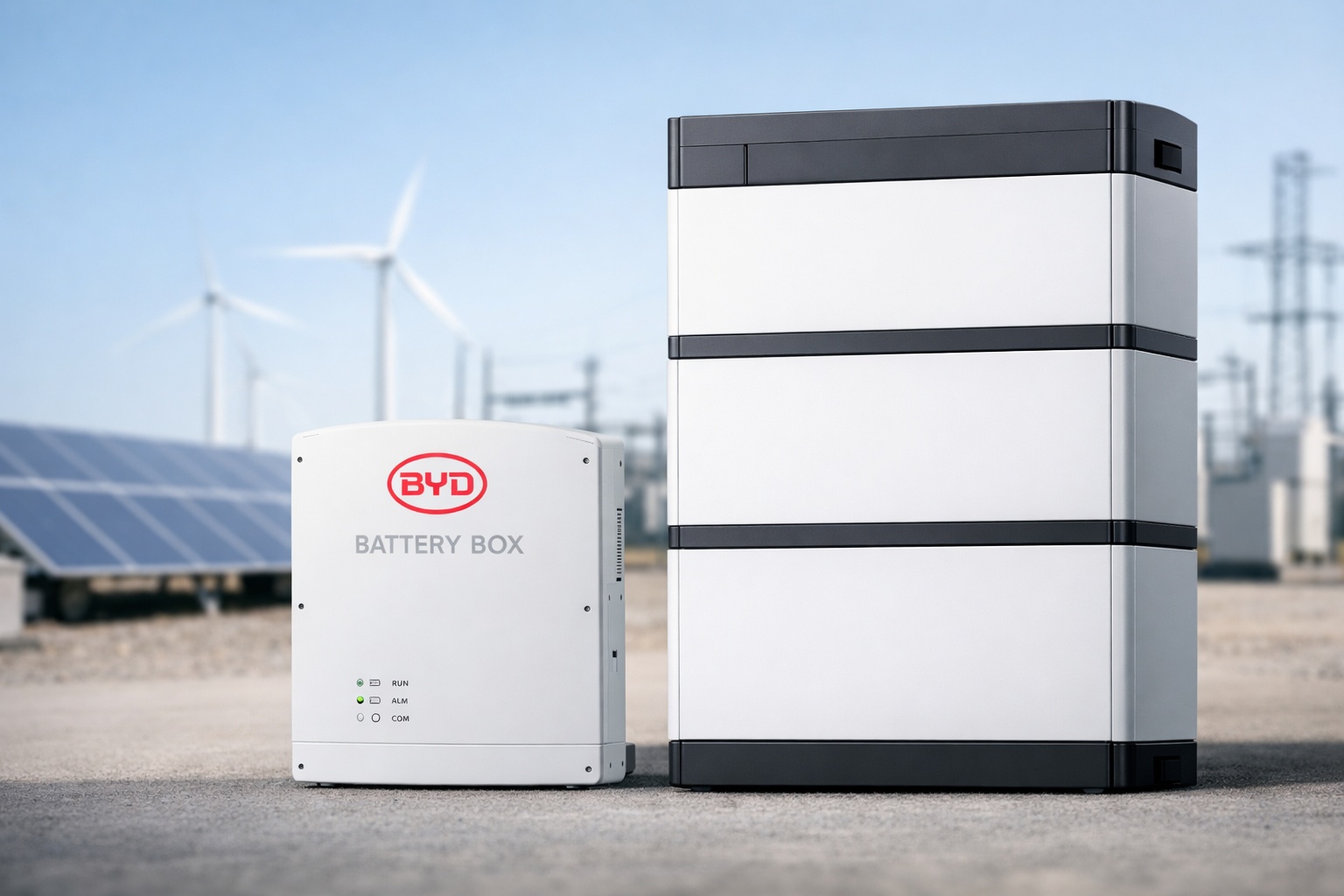
BYD Battery-Box in industrial installations is a topic that is easy to oversimplify. Several different battery storage families sit under one name, but they do not play the same role in an energy system. Some models are designed mainly for residential or light commercial use, while others move more clearly into the C&I segment, meaning commercial and industrial applications. So if the question is whether BYD Battery-Box is suitable for a plant, warehouse, logistics centre, or service premises with a heavier load profile, the real focus should not be the brand alone, but the specific product line.
This distinction matters in practice. It is easy to find broad marketing language from BYD about “flexible applications,” but the technical documentation is much more precise. And rightly so. In industrial settings, kWh capacity on its own is not enough. Voltage architecture, current limits, environmental conditions, inverter compatibility, scalability, remote diagnostics, and whether the system was genuinely designed as a C&I product all matter just as much as the energy figure.
There is no single “BYD Battery-Box for industry”
The most important starting point is simple: BYD does not have one Battery-Box family that can be safely described in a single sentence. The current portfolio includes the Battery-Box Premium HVS, HVM, LVS, and LVL lines, alongside the separate Battery-Max Lite and Battery-Max LiteIn systems. There is also the older Battery-Box Commercial line, which still appears in the documentation, but no longer looks like the main direction of development.
That is exactly why any discussion of BYD Battery-Box in industrial installations has to begin with model selection. HVS and HVM are inherently too small to be treated as classic industrial storage systems. LVS and LVL can move into light commercial applications or smaller technical systems, but their architecture brings its own limits. If the discussion is about genuine C&I use, then today the closest fit is Battery-Max Lite and Battery-Max LiteIn.
How do the different models look from an industrial perspective?
In simple terms, the range can be divided into three levels. The first is clearly residential or very small commercial systems. The second is larger-capacity solutions that still require careful attention to integration. And the third is storage designed from the outset for C&I applications.
| BYD family | System character | Capacity range | Typical place in a project |
|---|---|---|---|
| HVS | high-voltage, small-scale | 5.12–12.8 kWh per tower, up to 38.4 kWh total | home, small critical loads, light backup |
| HVM | high-voltage, larger than HVS | 8.28–22.08 kWh per tower, up to 66.2 kWh total | premium home, small business, light commercial systems |
| LVS | low-voltage, modular | 4–24 kWh per tower, up to 256 kWh | small business, agriculture, backup, off-grid |
| LVL 15.4 | low-voltage, energy-scalable | 15.36 kWh per unit, up to 983 kWh | larger indoor systems, but with clear DC-side limits |
| Battery-Max Lite | outdoor C&I cabinet | 30–90 kWh per cabinet, up to 900 kWh | commercial and industrial storage for peak shaving, backup, PV, EV charging |
| Battery-Max LiteIn | indoor C&I system | 30–82.5 kWh per rack, up to 825 kWh | technical plant rooms, indoor integration |
| Battery-Box Commercial C130/C230 | older C&I line | 131 / 233 kWh | existing systems, legacy projects |
This table does a better job of structuring the subject than the trade name alone. In practice, HVS and HVM are simply too small to be treated as the main storage systems for a typical industrial site. They can be used for auxiliary circuits, small server rooms, partial backup, or light service infrastructure, but that still does not place them in the same category as a conventional industrial battery installation.
LVS and LVL look more interesting because the energy scale becomes much more noticeable. But in industrial projects, energy alone is never enough. It matters just as much what voltage the system runs at, what the currents look like, how cable and protection complexity grows, and whether the full DC arrangement remains technically sensible.
HVS and HVM: good systems, but not for heavier C&I use
The HVS series scales from 5.12 to 12.8 kWh in one tower. Three identical towers in parallel give a maximum of 38.4 kWh. In HVM, one tower ranges from 8.28 to 22.08 kWh, and with three towers the total reaches 66.2 kWh. These are sensible values for a home, larger residence, small office, light technical site, or a modest critical-load application. For most industrial uses, however, they are still too limited.
The issue is not only energy. HVS has a maximum output current of 25 A, while HVM reaches 50 A. Even if system voltage is relatively high, the overall scale and operating logic of these batteries remain much closer to the residential segment than to industrial storage. In an industrial facility, the real question is not only how much energy can be stored, but how much power the system can actually deliver, for how long, and how it behaves under more dynamic loading.
That is why HVS and HVM make more sense where the battery is not intended to support a production process directly, but selected circuits instead: controls, auxiliary infrastructure, small UPS-type technical needs, or local backup. If the goal is peak shaving, wider backup for a warehouse or industrial unit, operation with a larger hybrid inverter, or meaningful management of the site’s power profile, these families usually run out of headroom too early.
LVS and LVL: more energy, but different limitations appear
LVS can reach 256 kWh, and LVL as much as 983 kWh. On paper, that already looks like a range worth considering seriously for a larger site. The problem is that in industrial systems, the kWh number alone is never enough. You also have to ask how that energy is assembled and what the DC side of the system looks like.
This is especially clear with LVL. One unit provides 15.36 kWh, has a nominal voltage of 51.2 V, and a continuous current of 250 A. It can also be paralleled up to 64 times. In energy terms, that gives almost 1 MWh, but the whole arrangement remains low-voltage. For industry, that has very specific consequences: high DC currents, greater importance of busbars and protection, more cabling, tighter requirements for the technical room, and a less elegant integration route than with a purpose-built high-voltage cabinet system.
That does not mean LVL has no place. It does, but in particular scenarios. It works where the owner accepts an indoor battery installation, has good environmental conditions, designs the balance of system properly, and needs a lot of energy without necessarily requiring the most compact C&I format. For an industrial site, though, it still looks more like a solution that can be engineered successfully than an obvious first choice.
Battery-Max Lite and LiteIn: this is where real C&I starts
With Battery-Max Lite and Battery-Max LiteIn, BYD moves into a segment that genuinely fits industrial and commercial applications. That is visible in the system architecture, the communication interfaces, and the intended operating scenarios.
Battery-Max Lite is an outdoor system with an IP55 enclosure rating. One cabinet ranges from 30 to 90 kWh. In the current datasheet, up to 10 cabinets can be connected, giving a maximum of 900 kWh. The system operates between roughly 307 V and 1065 V depending on configuration, supports CAN, RS485, and Modbus TCP, and is intended for on-grid, on-grid with backup, off-grid, and black start applications. That is already the language of a real C&I battery system.
LiteIn is the indoor counterpart. One unit ranges from 30 to 82.5 kWh, and the maximum current datasheet configuration reaches 825 kWh. Operating voltages are similar and communication is similar as well, but the enclosure rating is IP20, which means it is intended for technical rooms rather than outdoor placement.
| Model | Capacity range | Nominal voltage | Continuous current | Peak current | Operating temperature | Enclosure |
|---|---|---|---|---|---|---|
| Battery-Max Lite | 30–90 kWh per cabinet, up to 900 kWh | 307–921 V nominal depending on configuration | 100 A | 170 A for 3 s | -20 to +50°C | IP55 outdoor |
| Battery-Max LiteIn | 30–82.5 kWh per rack, up to 825 kWh | 307–844 V nominal depending on configuration | 100 A | 170 A for 3 s | -10 to +50°C | IP20 indoor |
This is already a scale that makes sense in real C&I projects
It is not yet the same as a large utility-scale battery plant, but it is enough to build sensible systems for PV self-consumption, peak shaving, backup for selected loads, EV charging support, or local off-grid arrangements.
At the same time, it is important to remember that capacity is not the only criterion. For Battery-Max Lite, BYD states a significant limitation: when multiple cabinets are connected in parallel, the maximum charge and discharge current per cabinet is reduced. This matters because in any C&I battery project, energy and power always have to be considered together. A high kWh figure does not automatically mean the system will retain the same power flexibility once expanded.
The key limitations of BYD in industrial applications
1. Inverter compatibility is not a minor detail, but a project condition
BYD links its battery systems very clearly to compatible inverter lists. This is not a small installation detail, but a system-level constraint. It means the battery project has to be built around a confirmed battery–inverter–connection topology combination. In the older Battery-Box Commercial line, the wording is especially restrictive and leads to a narrow compatibility window. In the newer product lines, there are more approved partners, but the principle remains the same.
For industry, this means less integration freedom than with storage systems designed as more open C&I platforms. If a site already has a defined inverter, PCS, or EMS ecosystem, only the latest compatible list can show whether a given BYD system is actually an option.
2. Parallel connection does not always scale in a simple linear way
In the HVS and HVM families, only identical towers with the same number of modules can be connected in parallel. During expansion, the state of charge of the existing system and new modules also has to be managed carefully. That makes sense from the perspective of safety and BMS operation, but in larger installations it is still an extra service and commissioning condition.
In Lite and LiteIn, the issue looks different. There, energy can be scaled in a way that makes more sense for C&I, but once more cabinets or racks are added, current and power limits per unit appear. That does not disqualify the system, but it does require careful calculation, especially where the design is meant to deliver not only energy capacity, but also stronger short-term power output.
3. Environmental conditions quickly divide the range into “yes” and “no”
This is one of the most practical limitations. HVS and HVM have IP55 and can be used indoors or outdoors. Lite also has IP55 and is designed for outdoor operation. LVS is also suitable for indoor and outdoor use in its intended configuration. But LVL and LiteIn are IP20 systems and therefore require an indoor environment.
In an industrial setting, that can be decisive. If the site has dust, high humidity, an aggressive atmosphere, major temperature swings, or simply no suitable technical room, IP20 stops being a neutral specification and becomes a real design constraint.
4. BYD documentation can change materially between versions
This is a very important point when working with international documentation. It is possible to find older Battery-Max Lite and LiteIn documents showing higher maximum scaling values than the latest datasheets. Older Lite material referred to multi-megawatt-hour scaling, while the current datasheet shows 10 cabinets and 900 kWh. For LiteIn, older traces in the documentation also pointed to higher limits than the current datasheet.
The conclusion is simple: in an industrial project, the first PDF found online is not good enough. Work should be based only on the latest datasheet, operating manual, warranty terms, and compatible list. Otherwise, it becomes very easy to build a concept around parameters that BYD no longer supports officially.
5. These are not battery systems for everything
BYD supports on-grid, backup, off-grid, and black-start scenarios, which is a real advantage in C&I applications. Even so, perspective matters. These are still battery systems that operate with a compatible inverter and a defined control structure, not a universal replacement for every industrial UPS arrangement, safety system, or high-end critical-power architecture.
In practice, they are well suited to peak shaving, solar self-consumption, partial backup, time-of-use optimisation, and integration with EV charging. But where the discussion concerns absolutely critical processes with very high continuity requirements and a specific redundancy strategy, a BYD battery on its own does not settle the whole issue. The full power architecture still has to be assessed.
Where does BYD Battery-Box make sense in industry?
The most sensible applications are those where the battery does not need to become the main energy source for the whole process, but instead improves the site’s economics and flexibility. That applies especially to PV self-consumption, peak shaving, short backup for selected loads, stabilising the local demand profile, and integration with EV charging infrastructure.
In those scenarios, Battery-Max Lite and LiteIn look convincing. They offer sensible energy ranges, modern communication interfaces, operation in several modes, and enough scalability for many industrial and service-sector sites. The key point, however, is to define honestly from the beginning how much energy and how much power the site actually needs.
Where is caution a better approach?
If a project requires very high energy and, at the same time, high short-term power, BYD needs to be sized very carefully rather than just “from the kWh figure”. The same applies to sites with difficult environmental conditions that do not allow IP20 equipment, or projects where the owner expects complete freedom in choosing PCS and integrating with any inverter.
Caution is also needed when someone tries to move into industry using HVS or HVM simply because those products are familiar from the residential market. Technically, they can be used in a small commercial property, but that does not automatically turn them into industrial storage systems. In heavier C&I use, their energy and system limitations usually appear sooner than their strengths.
Summary
BYD Battery-Box in industrial installations is not one product, but a group of battery storage families with very different purposes. HVS and HVM should be treated mainly as residential or light commercial solutions. LVS and LVL can move further up, but they require a careful approach to architecture and environmental conditions. In the real C&I segment today, the strongest fit is Battery-Max Lite and Battery-Max LiteIn.
The most important limitations do not lie only in cell chemistry or nominal capacity. They sit in inverter compatibility, voltage architecture, current behaviour when scaling, environmental conditions, and the fact that BYD guides the user quite clearly toward its own project logic. That means the equipment can be used effectively in industry, but only when the project is designed at system level, not around the product name alone.
Sources:
https://bydbatterybox.com/uploads/downloads/BBOX_LVS_Datasheet_EN_V1.0_240626_L-668f94bd814fd.pdf
https://bydbatterybox.com/uploads/downloads/BBOX_LVL_Datasheet_EN_V1.0_240626_L-668f948a29616.pdf
https://bydbatterybox.com/uploads/downloads/Datasheet_Battery-Max%20Lite_V1.7_EN_251105-6971e13d22247.pdf