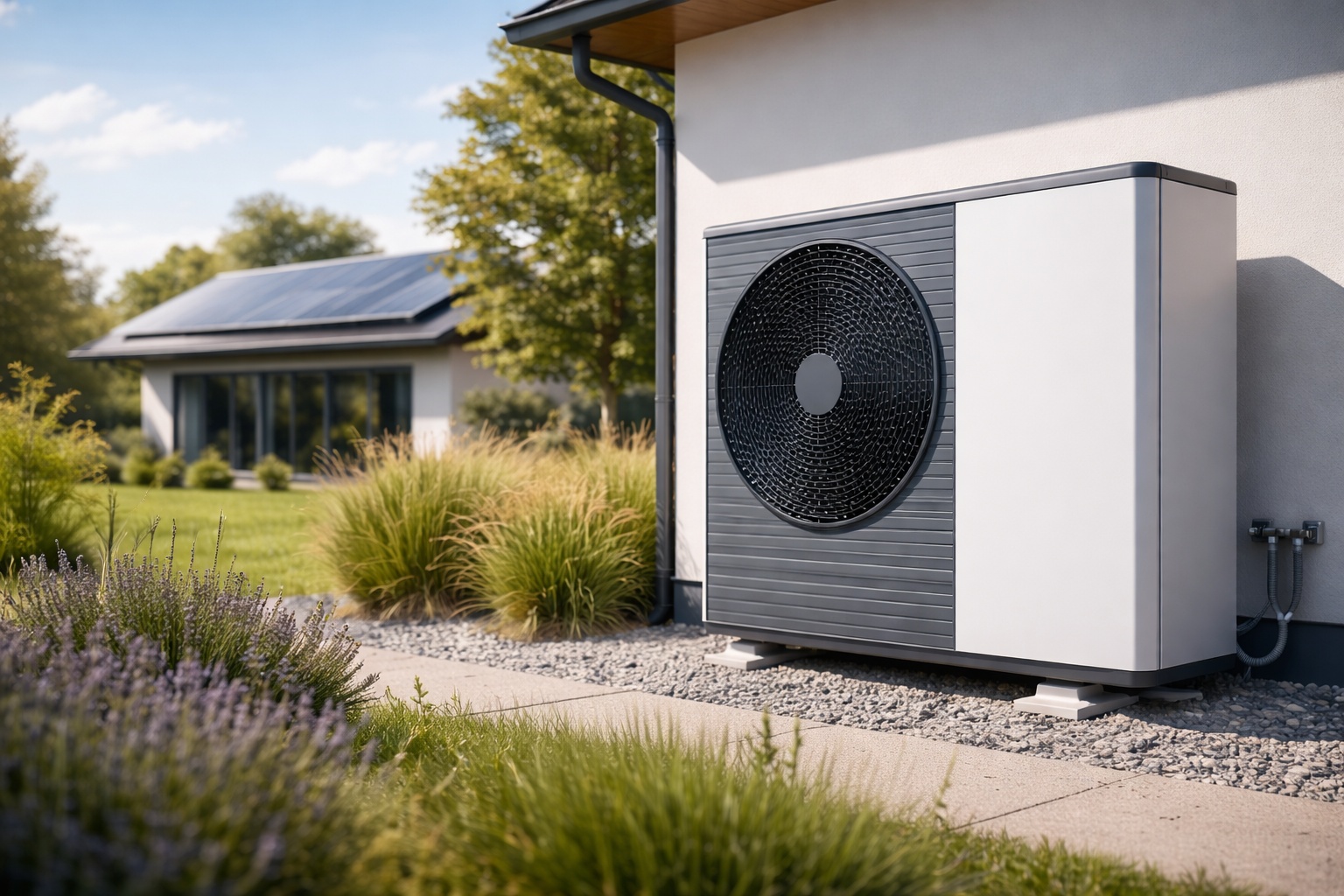
A 10 kW heat pump does not draw 10 kW of electrical power from the grid. That figure usually refers to the unit’s heating output, not its actual electricity consumption. This is the basic point that needs to be clarified from the start, because most misunderstandings begin հենց այստեղ.
Looking at manufacturer data, seasonal performance figures, and technical guidance, it becomes clear that electricity consumption is shaped not by the model label alone, but by the whole operating setup: flow temperature, outdoor temperature, the building’s heat loss, domestic hot water demand, the contribution of the backup heater, and the control settings. That is why two heat pumps in the same output class can still produce very different electricity bills.
10 kW is heating output, not electrical input
If a manufacturer states “10 kW”, that usually means the amount of heat the unit can deliver into the heating system under defined test conditions. It does not mean the unit continuously draws 10 kW of electrical power. Electricity consumption is much lower, but it changes with operating conditions.
This is very important when reading technical literature. One heat pump may have around 10 kW of heating output, yet at one moment it may draw around 2 kW, at another 3 kW, and in more demanding conditions more than that. That is why the question “how much electricity does a 10 kW heat pump use?” is too broad on its own. The next question has to be: in what kind of home, with what kind of heating system, and at what operating temperature?
What has the biggest effect on electricity use?
| Factor | What it changes | Effect on electricity use |
|---|---|---|
| Flow temperature | Whether the system runs, for example, at 35°C or 55°C | The higher the flow temperature, the higher the electricity use and the lower the efficiency |
| Outdoor temperature | Operating conditions for the outdoor unit | The colder it gets, the harder the heat pump has to work and the more electricity it will usually use |
| Building heat-loss standard | The amount of heat the building loses | The greater the heat loss, the longer and harder the heat pump has to run |
| Type of heat emitters | Underfloor heating or radiators | A lower-temperature system usually supports lower consumption |
| Domestic hot water | Cylinder temperature and the intensity of DHW preparation | High DHW temperatures increase consumption, especially if the backup heater comes on |
| Backup heater | Additional heating in cold weather or during high demand | This is one of the most common reasons for higher-than-expected bills |
| Controls and settings | Weather compensation curve, schedules, operating logic | Poor settings can raise electricity use even with a correctly sized heat pump |
| Defrost cycles and auxiliary loads | Supporting components and defrost operation | These are not usually the main cost driver, but they do affect seasonal performance |
Flow temperature matters enormously
This is usually the most important factor after the building itself. A heat pump operating at a lower flow temperature, typical of underfloor heating, will usually use less electricity than the same unit working at the higher temperatures often required by parts of a radiator system.
This is easy to see in technical data. For a unit in the 10 kW range, the manufacturer may show clearly better performance at A7/W35 than at A7/W55. That is not a minor catalog detail. It translates into a real difference in running costs. The higher the required water temperature, the harder the compressor has to work and the lower the overall efficiency becomes.
From what I see when analysing systems like this, this is exactly where users most often underestimate the scale of the issue. The heat pump itself may be perfectly good, but if the building or heating system forces it to run at high temperatures, the final bill can look much worse than expected.
Outdoor temperature changes everything too
The second pillar is the condition on the heat-source side. With an air-to-water heat pump, the lower the outdoor temperature, the harder it is to extract heat from the air and the more electricity is needed to deliver the same amount of heat into the building.
This is very clear in charts and product data. At milder outdoor temperatures, the unit may operate with a strong COP. In frosty weather, efficiency drops and electricity use rises. On top of that, the outdoor unit has to defrost, and over a full heating season that also affects the final energy balance.
So the electricity bill is not driven only by the “size” of the heat pump, but also by how often and how long it has to run in more difficult winter conditions.
The building often matters more than the heat pump itself
This is worth stating directly: in many cases, the building has more influence on running costs than the differences between brands or heat pump models.
If the home loses a lot of heat, any heat pump will have to run longer and harder. If the building is well insulated and has a lower heat demand, electricity consumption drops. That is why two homes with a 10 kW heat pump can end up with completely different annual costs.
Below is a simple model showing the scale of the difference.
Illustrative annual electricity use for a 150 m² home
Assumption for the example: a simplified seasonal efficiency of SCOP = 4.0.
| Home type | Indicative heat demand | Annual demand for 150 m² | Estimated electricity use at SCOP 4.0 |
|---|---|---|---|
| Better-insulated newer home | 70–90 kWh/m²·year | 10,500–13,500 kWh/year | 2,625–3,375 kWh/year |
| Improved older home | 100–160 kWh/m²·year | 15,000–24,000 kWh/year | 3,750–6,000 kWh/year |
| Older less efficient home | 170–200 kWh/m²·year | 25,500–30,000 kWh/year | 6,375–7,500 kWh/year |
This is only a simplified model, but it makes the key point clearly: the same heat pump class can have very different annual electricity consumption depending on the building. That is exactly why the figure “10 kW” tells you very little about the final bill on its own.
COP and SCOP are not the same thing
When looking at electricity use, two terms need to be separated: COP and SCOP.
COP refers to one specific operating point, for example at a defined outdoor temperature and a defined flow temperature. That is useful technical information, but it does not tell you how much electricity the unit will use across a full heating season.
SCOP shows seasonal heating efficiency. It is much closer to real operation. If the goal is to estimate annual electricity use, SCOP matters much more than one attractive COP figure from a brochure.
It is also clear from certification and seasonal performance guidance that the same heat pump can show noticeably different seasonal results in low-temperature and medium-temperature applications. That is another reminder that the heating system and operating conditions matter just as much as the unit itself.
Domestic hot water can push bills up significantly
In simple comparisons, many people look only at space heating and ignore domestic hot water. That is a mistake.
If the heat pump regularly has to heat the cylinder to a high temperature, electricity use rises. The higher the domestic hot water temperature, the less favourable the operating conditions become for the heat pump. In some systems, higher target temperatures also bring in the backup heater or immersion heater. When that happens, the cost of hot water production rises much faster than when the compressor is doing the work alone.
In a home with high hot water demand, this can become a meaningful part of the total electricity bill, especially if the cylinder is being held at a higher temperature than is actually needed.
The backup heater is a common reason for high bills
If someone asks why their electricity bills are higher than expected, the answer is very often hiding here.
The heat pump itself may be working properly, but in harder frosts, with poor system settings, or with excessively high flow temperatures, it starts relying on the electric backup heater. And once the backup heater is running, the system is effectively turning electricity directly into heat. There is no longer the same heat-pump effect of moving energy from the outside environment, so the cost rises much faster.
In a well-designed system, the aim is to keep the backup heater’s contribution as low as possible. If it is running frequently, that usually means the issue does not sit only in the heat pump itself, but in the whole configuration: the building, the heating system, the settings, or the way the system is being used.
Auxiliary consumption exists too
The final bill also includes auxiliary loads: standby power, electronics, pumps, controls, and in some systems other supporting functions linked to operation.
These are not usually the biggest numbers, but they do not disappear entirely. Over a full year they are not usually the main cause of high bills, but in any honest running-cost assessment it is worth remembering that a heat pump does not use electricity only when it is actively heating the home.
What is the most sensible way to look at electricity use for a 10 kW heat pump?
The safest order of analysis looks like this:
- first establish the building’s heat demand,
- then analyse the heating system’s flow temperature,
- next check the unit’s seasonal efficiency,
- and only after that compare the nominal output of the heat pump itself.
Reversing that order leads to poor expectations. A 10 kW heat pump in a newer home with underfloor heating may use a moderate amount of electricity. The same output class in an older home with radiators and higher flow temperatures may produce much higher bills. The problem does not necessarily sit in the technology itself, but in the conditions in which it has to operate.
Summary – electricity use of a 10 kW heat pump
The electricity consumption of a 10 kW heat pump depends mainly on five things: the building’s heat demand, the flow temperature, the outdoor temperature, domestic hot water production, and the role of the backup heater. The figure “10 kW” on its own says far too little to predict the bill honestly.
If one rule has to be given, it is this: electricity use is driven not by the heat pump alone, but by the whole system. That is why, when assessing running costs, a well-matched building, heating system, and seasonal efficiency figure usually tell you more than the model name on the front of the unit.
Sources
GOV.UK – Heat pumps explained: experts answer your questions:
https://www.gov.uk/government/news/heat-pumps-explained-experts-answer-your-questions
GOV.UK – What impact can heat pumps have in domestic heating today, and how might that change over time as technology improves?:
https://www.gov.uk/government/publications/heat-pumps-for-domestic-heating/what-impact-can-heat-pumps-have-in-domestic-heating-today-and-how-might-that-change-over-time-as-technology-improves-html
Ofgem – Easy Guide to Heat Pumps:
https://www.ofgem.gov.uk/sites/default/files/docs/2021/04/easy_guide_to_heat_pumps_final_2021_0.pdf