Modern metallurgical processes in steel production no longer end with the melt itself. Quality, cost, and emissions are shaped by the entire chain: preparation of the metallic charge, selection of the steelmaking route, refining of liquid steel, continuous casting, and, increasingly, the way the steel plant is linked to rolling. That is why it is no longer possible to discuss modern steel production honestly only through the lens of the blast furnace or the electric arc furnace.
The industry is now operating under three simultaneous pressures. The first is quality and consistency, because the share of more demanding grades keeps rising. The second is energy and cost, because steelmaking remains a highly energy-intensive system. The third is emissions, because the still-dominant blast furnace route is also the most environmentally burdensome. For that reason, the development of steelmaking is moving in two directions at once: better control of liquid steel and casting, and a shift toward EAF, DRI, and technologies based on electrification and hydrogen.
What do modern metallurgical processes in steel production mean today?
In technical terms, modernity now means combining several characteristics at the same time: better control of chemical composition, higher metallurgical cleanliness, improved yield, lower energy intensity, and the ability to cut emissions further over time. Simply changing the heat source or reductant does not solve much on its own if dissolved gases, non-metallic inclusions, bath temperature, or solidification conditions in the caster are still poorly controlled.
It is also worth separating three process levels that are often mixed together in one narrative. The first concerns the production of primary iron from ore or the preparation of clean iron units for the EAF. The second covers steelmaking itself and the refining of steel. The third is the stage at which liquid steel is stabilised, cleaned, and cast into semi-finished products. Only looking at the full chain shows where real technological progress is taking place.
The main steel production routes: BF-BOF and EAF
Global production still relies mainly on two routes. The first is the integrated BF-BOF route, meaning the blast furnace and basic oxygen furnace. The second is the electric arc furnace, or EAF, operating on scrap, DRI, HBI, or a mix of different metallic charge materials. Data for 2024 show that 70.4% of global steel production came from oxygen routes, while 29.1% came from electric routes. That is a good picture of the starting point: the transition is already under way, but the weight of the market still rests on conventional integrated steelmaking.
The main differences
The difference between these routes does not come down only to how the furnace is powered. BF-BOF runs on iron ore, coke, fluxes, and some scrap, which makes it well suited to very large scale and stable production of primary steel. EAF offers greater flexibility, fits better into circular material use, and is easier to combine with lower-carbon electricity, but its quality potential depends heavily on the charge mix. When the furnace operates only on scrap of variable quality, residual elements become a much bigger issue and it becomes harder to maintain high cleanliness for more demanding grades.
| Route | Main inputs | Strengths | Main limitations |
|---|---|---|---|
| BF-BOF | iron ore, coke, fluxes, some scrap | very large scale, stable ore-based production, strong position in integrated steelworks | high emissions, dependence on coking coal, and extensive infrastructure |
| Scrap-EAF | steel scrap, electricity | flexibility, strong fit with circular material use, lower emissions than BF-BOF | dependence on scrap quality and availability, more difficult control of residual elements |
| DRI/HBI-EAF | DRI, HBI, scrap, electricity | cleaner charge, better chemistry control, a strong lower-carbon direction | requires suitable ore quality, gas or hydrogen, and new infrastructure |
This comparison shows one important thing: the industry is not moving toward one universal model. A mixed structure is more realistic. BF-BOF will remain important for a long time wherever huge scale and existing infrastructure still matter. EAF will continue to grow because it offers greater investment flexibility and responds better to emissions pressure. Between the two, DRI and HBI are becoming more important as clean iron units that strengthen the electric route wherever scrap alone is not enough.
BF-BOF still defines the reference point
The blast furnace route remains the foundation of large integrated steel plants, especially where production is based on ore and very high volumes of primary steel. Today, its development is not about reinventing the process from scratch, but about ever-better control of burden preparation, blast furnace stability, use of process energy, and integration with precisely managed secondary metallurgy. It is still a very efficient model for large sites.
At the same time, this is the most emissions-intensive route. According to worldsteel, the average CO2 emissions intensity for BF-BOF is 2.32 t CO2 per tonne of crude steel, while for DRI-EAF it is 1.43 t and for scrap-EAF it is 0.70 t. That does not automatically mean every EAF route is low-emission, because much depends on the electricity mix and the charge materials. It does, however, show very clearly why the strongest transition pressure is focused on the conventional blast furnace route.
EAF is now the platform of the modern steel plant, not just a scrap furnace
The biggest change in recent years is that the EAF is no longer seen only as a furnace for remelting scrap. In modern electric setups, different combinations of scrap, DRI, HBI, pig iron, and other iron-bearing materials are charged into the furnace. That kind of configuration makes it possible to reduce the influence of residual contamination, stabilise charge chemistry, and widen the range of grades that can be produced via the electric route.
For that reason, solutions that improve energy performance and the operating smoothness of the EAF are gaining importance. A good example is Consteel, where the charge is fed and preheated continuously using the furnace off-gases. This is not a minor improvement. It changes the character of furnace operation, reduces process fluctuations, improves energy use, and creates more predictable melting conditions than a classic batch-charging setup.
DRI and HBI: clean iron units are becoming strategic
In modern steel production, DRI and HBI are becoming more important because they solve a problem that scrap alone cannot remove. Scrap remains the foundation of circular material use, but it does not always provide a sufficiently clean and consistent charge for more demanding grades. DRI and HBI give the electric steel plant a more controlled source of iron, making it easier to maintain quality and limit the influence of unwanted elements.
That is exactly why today’s electric steel plant increasingly does not choose between scrap and DRI, but combines the two. Scrap provides flexibility and a closed material loop, while DRI or HBI improve charge quality and open the way to more stable production of higher-grade steel. In the end, what matters is not the name of the feed material, but whether the furnace receives a charge whose metallurgical behaviour can be predicted.
| Charge material | Main advantage | Main limitation | Effect on steel quality |
|---|---|---|---|
| Scrap | circular material use, broad availability in many regions | variable quality, residual elements | good for many grades, but less predictable for higher-specification products |
| DRI | clean iron units, good chemistry control | requires suitable ore quality and a direct reduction installation | improves stability and metallurgical cleanliness |
| HBI | easier to transport and store than DRI | higher preparation cost than ordinary scrap | like DRI, it strengthens the EAF route from a quality perspective |
The higher the requirements placed on the finished steel, the less willing producers are to rely only on scrap of uncertain quality. That is why the growth of DRI and HBI is not a passing fashion, but a response to a specific metallurgical limitation.
H2-DRI is the most realistic route for lower-emission steel production from ore
Among the new technology directions, H2-DRI currently holds the strongest position. This means direct reduction of ore using hydrogen combined with the EAF route. It connects two worlds: production of iron from ore and electric steelmaking. It is therefore a natural candidate for replacing part of the primary production that has so far depended on the blast furnace.
This solution has not yet become the global standard, but it is now the most mature transition route for primary production without a blast furnace. Installations are already being developed to operate on up to 100% green hydrogen, producing HDRI for direct charging into the steel plant or HBI for further use. At the same time, commercial projects show that the industry has stopped treating this direction as purely experimental.
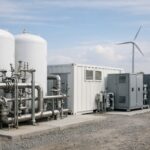
The biggest challenges no longer lie in the basic process principle itself, but in the surrounding infrastructure. Suitable iron ore pellets are needed, together with cheap and reliable access to electricity, hydrogen with the lowest possible emissions footprint, and storage systems capable of smoothing supply fluctuations. That is exactly why industrial-scale hydrogen storage is becoming so important for steelmaking.
Modern metallurgical processes – secondary metallurgy
If the subject is to be treated honestly, it cannot stop at the level of BF-BOF or EAF. The quality of final steel is very often decided only in secondary metallurgy. This is where the final chemical composition is adjusted, temperature is stabilised, dissolved gases are reduced, and the condition of the liquid metal is brought under control before casting.
Without this part of the process, modern production of high-quality steel simply does not exist. The more demanding the grade, the greater the role of treatment outside the main furnace. For ordinary structural steels, the tolerance margin is wider. For ultra-low-carbon steels, specialty steels, stainless steels, or high-quality flat products, that margin narrows sharply.
Ladle furnace
The ladle furnace is used for composition correction, reheating, and slag treatment in conditions that are far more controlled than those of the primary melt. It is a key stage for stabilising temperature and chemistry before casting. The more demanding the grade, the more important the precision of this stage becomes.
Vacuum degassing and RH
As quality requirements rise, reheating and chemistry correction are no longer enough on their own. The level of dissolved gases also has to be reduced and metallurgical cleanliness improved. This is where vacuum systems come in, and for high volumes and ultra-low-carbon steels, RH units become especially important. Their role is to deliver effective degassing and decarburisation while maintaining high productivity.
| Operation | Main function | Why it is needed |
|---|---|---|
| Ladle furnace | composition correction, reheating, slag treatment | stabilisation of temperature and chemistry before casting |
| Vacuum degassing | removal of dissolved gases | reduction of hydrogen, nitrogen, and quality defects |
| RH | circulation degassing and decarburisation | production of large volumes of high-quality steel, including ultra-low-carbon grades |
The logic of this comparison is simple. High quality does not come from one step alone, but from a sequence of precisely controlled operations. A modern steel plant is modern when it can prepare liquid steel for casting in a predictable way.
Continuous casting has become the global norm in steelmaking
The biggest transformation in modern steel production has already taken place, and it is continuous casting. In 2024, 97.5% of the world’s steel was cast continuously. That means traditional ingot casting is now the exception rather than the rule.
The importance of continuous casting does not come down only to higher productivity. This technology delivers better yield, greater consistency, lower energy losses, and much more control over solidification conditions. That is why modern casting is not just the casting machine itself, but a whole set of tools for strand quality control, defect reduction, and process stabilisation. Mould monitoring, secondary cooling control, and techniques such as electromagnetic stirring are playing an ever-greater role.
Process shortening: thin slab, CSP, and integration with rolling
A large part of metallurgical progress today does not come from adding more stages, but from shortening them and linking them more effectively. That is why thin slab casting and systems in which casting and rolling are tightly integrated are becoming more important. This kind of model reduces temperature losses, lowers the need for reheating, and improves the operational rhythm of the plant.
This is an important change in thinking. Modernity increasingly means not a single machine, but the architecture of the entire line: from charge preparation, through the furnace and ladle, to casting and rolling. The fewer unnecessary thermal and transport interruptions there are along the way, the greater the chance of lower unit costs and more stable quality.
Smelting reduction and electrolysis: important directions, but not yet the new standard
Alongside DRI, a second direction is developing: smelting reduction. Its logic is to limit part of the conventional burden preparation required for the blast furnace route, especially coking and sintering, while still retaining the ability to produce hot metal from ore. This is an important direction because it offers a different transition path from H2-DRI and may be attractive wherever a full move to hydrogen is more difficult from an organisational or energy perspective.
An even more radical direction is ore electrolysis. This approach is attractive because, in principle, it removes both coke and hydrogen as direct reductants. But the distinction between potential and present industrial scale needs to be made very clearly. This remains a developing technology, not a pillar of global steel production here and now.
What really defines a modern steel plant today?
The most accurate answer is that modern metallurgical processes define a site that can control the charge, the liquid steel, and the downstream process as one coherent system. Emissions are not the only issue. What also matters is the ability to maintain quality, achieve high material yield, reduce energy losses, and be ready to move toward lower-carbon energy carriers or reductants whenever economics and infrastructure allow.
| Area | More conventional model | Modern model |
|---|---|---|
| Charge | greater dependence on one dominant source | mixed, more tightly controlled metallic charges |
| Steel plant | focus on the melt itself | strong linkage between melting, refining, and automation |
| Secondary metallurgy | support for the process | the core of quality and consistency |
| Casting | final stage | key element of yield, quality, and integration with rolling |
| Emissions | optimisation within the limits of the old route | designed for electrification, DRI, and lower-emission options |
| Process control | local optimisation of individual stages | integrated management of the full chain |
The difference therefore does not come down to one machine. A more advanced plant is above all more predictable, cleaner metallurgically, better linked from an energy perspective, and more prepared for changes in both the charge mix and the energy mix. That direction, rather than one single “breakthrough furnace,” is what now defines the industry’s development.
Summary – Modern metallurgical processes
Modern metallurgical processes in steel production do not mean the end of conventional steelmaking, but its gradual reconstruction. BF-BOF still dominates, but it is under the greatest emissions pressure. EAF is growing and becoming the central platform for new investments. DRI and HBI strengthen the electric route wherever the scrap base alone is not sufficient from a quality point of view. H2-DRI now appears to be the most realistic route for lower-emission steel production from ore.
At the same time, it is becoming increasingly clear that final steel quality is determined above all by secondary metallurgy and continuous casting. That is where temperature, gases, metallurgical cleanliness, and solidification conditions are controlled. The future of steel therefore does not depend on one breakthrough alone, but on the combination of a cleaner iron source, more precise treatment of liquid metal, and a better integrated process from furnace to semi-finished product.
Sources:
https://worldsteel.org/wp-content/uploads/World-Steel-in-Figures-2025.pdf
https://www.iea.org/reports/breakthrough-agenda-report-2025/steel
https://www.primetals.com/en/portfolio/solutions/steelmaking/secondary-metallurgy/rh-degasser