
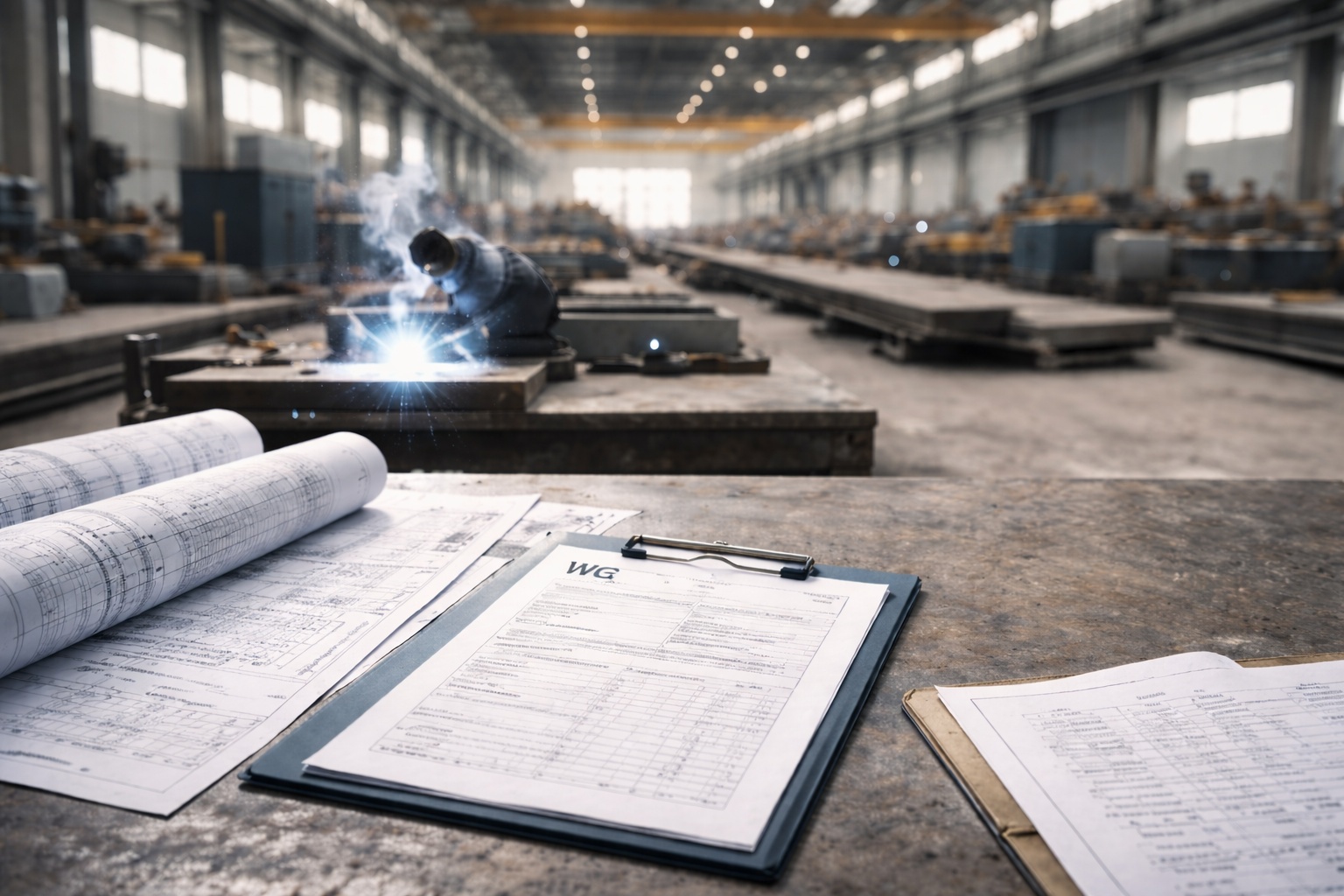
ISO 3834 is a standard that defines quality requirements for welding where final inspection of the finished product alone is not enough. This matters greatly in manufacturing plants because welding is a special process. If something goes wrong at the stage of technology, materials, personnel qualifications, or supervision, the finished weld may look acceptable and still fail to meet the design or service requirements.
That is why ISO 3834 is not simply a standard “about welding”. It is a system of quality requirements covering the full manufacturing process for welded products made from metallic materials. For a company, this means technical documentation, personnel qualifications, material control, production supervision, and quality records all have to be organised properly. In practice, these are exactly the areas that decide whether a facility can manufacture consistently and safely, or whether it merely “welds because it can”.
What is ISO 3834 and why is it important?
ISO 3834 is a series of standards that sets out quality requirements for fusion welding of metallic materials. It does not replace design standards, product standards, or a general quality management system. Its role is more specific. It is intended to ensure that the welding process is prepared, controlled, and documented in a way that matches the level of responsibility of the product.
This is especially important in factories manufacturing steel structures, tanks, piping systems, machine components, pressure equipment, or other products where weld quality affects safety, durability, and the manufacturer’s liability. In such industries, the issue is not just the weld itself. The issue is the whole system behind that weld.
Many companies operate for years without a structured welding quality system. It is only when customer requirements, a certification audit, or entry into a more demanding market appear that it becomes clear that workshop experience alone is no longer enough. ISO 3834 brings order to exactly this area.
Structure of ISO 3834
The ISO 3834 series consists of several parts. Each part has a different role, and together they form one coherent system for assessing welding quality requirements.
| Part of the standard | Scope |
|---|---|
| ISO 3834-1 | criteria for selecting the appropriate level of quality requirements |
| ISO 3834-2 | comprehensive quality requirements |
| ISO 3834-3 | standard quality requirements |
| ISO 3834-4 | basic quality requirements |
| ISO 3834-5 | documents required to claim conformity with ISO 3834-2, ISO 3834-3, or ISO 3834-4 |
This table shows the basic logic of the standard clearly. ISO 3834 does not work on a simple binary basis. It is not just “compliant” or “non-compliant” in isolation from the level of risk. First, the company has to determine what level of quality requirements is appropriate for the product, the process, and the consequences of a failure. Only then can the correct level be selected.
The three most important levels are comprehensive, standard, and basic. For manufacturers of safety-critical structures, especially load-bearing or pressure-retaining products, ISO 3834-2 is usually the relevant level. It sets the most extensive requirements and demands detailed control of processes, personnel, materials, and quality records. ISO 3834-3 and ISO 3834-4 apply where the product is simpler and the consequences of failure are less critical.
This is also where many companies make their first mistake. They hear “ISO 3834” and treat it as one certificate with one fixed set of requirements. But saying that a plant “has ISO 3834” without specifying the level and scope does not say enough. From the point of view of the customer, the auditor, and technical responsibility, what matters is whether it is level 2, 3, or 4, and for what scope of production.
Which areas of the production facility does ISO 3834 cover?
The biggest misunderstanding around this standard is reducing it to the welder and the welder’s qualification. ISO 3834 covers a much wider scope. It applies to the whole system of preparation, execution, and control of the welding process.
| Site area | What does this requirement concern? |
|---|---|
| review of technical requirements | analysis of drawings, specifications, contract requirements, and customer expectations |
| production planning | definition of process flow, sequence of operations, and execution conditions |
| welding procedures | preparation and approval of WPS documents and procedure qualification |
| personnel | qualifications of welders, welding coordination staff, and inspection personnel |
| materials | identification, incoming inspection, storage, and traceability |
| equipment | suitability and control of welding and measuring equipment |
| inspection and testing | monitoring of weld quality and recording of results |
| quality documentation | full traceability of the process and proof of conformity |
This table shows clearly that ISO 3834 is not a standard about one technical operation. It is a standard about an organisation’s ability to control the welding process. In a manufacturing plant, that means a skilled welder and a modern welding machine are not enough. A system is needed that covers preparation, execution, inspection, and documentation.
This is exactly why ISO 3834 often exposes a company’s weak points. Suddenly it becomes clear that technical requirements have never been formally reviewed, filler materials have not been identified correctly, welding parameters existed only “in the technician’s head”, and inspections were carried out without a coherent record system. Production may have been running for years, but the audit shows how much of it was based on habit rather than on a controlled process.
This is where the practical value of the standard lies. ISO 3834 does not create artificial paperwork for its own sake. It formalises practices that should already exist in a responsible manufacturing organisation, but which have often been handled informally until now.
Welding procedure qualification and technical documentation
One of the key requirements of ISO 3834 is that a facility must not weld “by feel”. The process has to be documented, verified, and repeatable. That is where technical documentation becomes essential, because without it, it is difficult to claim real compliance with the standard.
| Document | Role in the welding quality system |
|---|---|
| WPS | welding procedure specification defining how the weld is to be made |
| WPQR | welding procedure qualification record confirming that the procedure has been validated |
| work instructions | detailed implementation requirements for a specific production context |
| parameter and production records | evidence that the process was carried out in line with the requirements |
The mere existence of these documents is not enough. The key issue is whether they match the real production process. In many plants, the documentation exists on paper but is not aligned with what actually happens on the shop floor. A WPS may exist, but it may not match the actual thicknesses, welding positions, or materials used in the project. From an audit perspective, that kind of document gives no real assurance.
The second important point is the role of the WPQR. This is what separates a technologically organised plant from one working only on accumulated workshop experience. Procedure qualification demonstrates that a given method, under defined parameters and for a given material combination, has been verified. Without that, it is difficult to prove that the process is repeatable and capable of meeting quality requirements.
In industrial practice, this is often where the biggest problems appear on more demanding projects. The customer expects not only a finished product, but also proof that the manufacturing process was carried out to an appropriate technical standard. ISO 3834 places strong emphasis on this, because without it the whole welding quality system would be only a declaration.
Welding personnel and supervision
No welding quality system can work without people who genuinely understand the process. ISO 3834 requires not only qualified welders, but also proper supervision and competent personnel responsible for control and inspection.
| Staff group | Significance for the plant |
|---|---|
| welders | carry out welds in accordance with approved procedures and within the scope of their qualifications |
| welding coordination | is responsible for preparation, coordination, and supervision of welding activities |
| NDT personnel | carry out non-destructive testing and assess weld conformity |
| quality control staff | verify that the product and documentation meet the specified requirements |
Most attention usually goes to the welders because their work is the most visible. That matters, but it is not the whole picture. In manufacturing plants, process stability is often determined more by welding coordination than by any single operator. That function is responsible for making sure that the procedure is selected correctly, joints are planned properly, materials are suitable, and any problems are resolved systematically rather than ad hoc.
ISO 3834 is very clear on this point. Good weld quality does not come from workshop experience alone. It requires someone who can connect design, technology, execution, and inspection. In practice, the lack of effective welding coordination is one of the most common sources of chaos. Production continues, but everyone works in their own way, and sooner or later this affects both quality and documentation.
It is also worth remembering that the standard does not stop at welding itself. NDT personnel and those responsible for quality control must also work in a systematic and competent way. In responsible manufacturing, testing cannot be just a formal box-ticking exercise at the end of a stage. It has to be part of a genuine verification system.
Materials, filler materials, and traceability
In welding, quality starts before the arc is struck. ISO 3834 places strong emphasis on material control, because without it, even a correctly executed weld may become part of a defective product.
| Area | What the standard requires |
|---|---|
| parent materials | conformity with documentation and traceability |
| filler materials and consumables | correct selection, control, and storage |
| deliveries | verification of conformity with the order and specification |
| traceability | ability to link materials to products and quality records |
| storage | conditions that prevent deterioration of the material |
This is not bureaucracy for its own sake. In real industrial work, consumables and the way they are handled are one of the most common sources of problems. Poor storage, mixed batches, missing links to documentation, or weak incoming control can undermine all the effort put into the welding process itself.
The second important factor is traceability. In simple products, this is sometimes neglected, but in responsible manufacturing it is essential. The plant has to know what material the product is made from, what filler materials were used, who performed the welding, which procedure was applied, and what the inspection results were. Only then can we speak about a real quality system.
From an audit perspective, this area quickly shows whether a facility operates in a mature way. A company may have skilled welders and visually good products, but if it cannot clearly connect the material to the documentation and to the finished product, it still has a serious weakness from the standpoint of controlled manufacturing.
Production planning and preparation of the welding process
ISO 3834 does not treat welding as a single operation carried out at the end of production. It places strong emphasis on preparation, because this is where it is decided whether the process will be stable or whether it will generate rework and non-conformities.
| Planning element | What needs to be decided |
|---|---|
| sequence of operations | the order of assembly and welding |
| joint preparation | preparation of the joint before welding |
| execution conditions | temperature, environment, and accessibility of the workstation |
| inspection points | when and how inspections and acceptance tests are to be carried out |
| production organisation | who is responsible for the individual stages and decisions |
This area is often overlooked by companies that have long specialised in simpler projects. In straightforward production, many issues can be solved directly on the shop floor. The problem starts when structural complexity, the number of joints, customer requirements, or the level of formalisation increase. That is when the lack of proper preparation becomes visible immediately.
Good planning of welding operations reduces rework, limits the risk of distortion, makes quality control easier, and improves repeatability. From a cost perspective, that matters a great deal. The most expensive errors are usually not the ones seen immediately, but the ones discovered only after several production stages or during final inspection.
This is exactly why ISO 3834 looks so broadly at process preparation. It is not only about welding technology, but about the whole manufacturing process. In a mature plant, the planning stage decides whether production will run smoothly and predictably or be driven by ad hoc decisions.
Quality control and weld testing
Quality control under ISO 3834 is not an afterthought. It is an integral part of the system. The standard requires a facility to have defined methods of verifying quality and to know when and to what extent they need to be used.
| Method | Scope of application |
|---|---|
| VT | basic visual examination of welds and workmanship |
| PT | detection of discontinuities open to the surface |
| MT | detection of surface and near-surface discontinuities in ferromagnetic materials |
| UT | ultrasonic volumetric examination of welds |
| RT | radiographic volumetric examination |
The table helps organise the methods, but the most important conclusion is practical. No inspection method can repair a badly designed process. This is one of the central ideas of ISO 3834. Welding is treated as a special process precisely because final inspection has limited ability to “save” mistakes made earlier. Non-conformities may be detected, but that does not mean the system itself was sound.
The second point concerns the scope of testing. In responsible manufacturing, it is not set randomly or by habit. It is determined by design requirements, product class, quality level, customer requirements, and the expected level of reliability. The manufacturer has to be able to justify this and document it consistently.
An effective welding quality system is not about doing “a lot” of testing. It is about testing correctly and at the right stage. That is the difference between a plant that has its process under control and one that tries to use final inspection to compensate for poor preparation.
Quality documentation and production records
ISO 3834 requires a company not only to carry out quality-related activities, but also to be able to prove that it has done so. In responsible manufacturing, the absence of a record is very often treated as equivalent to the activity not having been carried out.
| Document type | Practical significance |
|---|---|
| WPS and WPQR | proof that the procedure has been properly prepared and qualified |
| personnel qualifications | confirmation of the competence of operators and supervisors |
| material certificates | link between materials and the finished product |
| inspection reports | evidence of examinations and their results |
| production records | confirmation of process flow and compliance with specifications |
This is the area many companies dislike most because it appears to involve the most paperwork. In reality, quality documentation is the backbone of responsible manufacturing. Without it, the process cannot be defended in front of a customer, a certification body, or an auditor, nor in the event of a complaint or technical dispute.
The second point is more practical. Well-maintained documentation also helps to organise the workplace internally. It makes it easier to identify the root cause of a problem, reconstruct production history, locate where a non-conformity appeared, and reduce the risk of repeating the same mistake. This is not only a formal obligation. It is a management tool.
In companies that implement ISO 3834 in a mature way, documentation is not treated as a burden, but as a tool for consistency. In companies that implement it only for appearance’s sake, this is exactly the area where the gap between the system and the reality of the shop floor is usually the largest.
ISO 3834 and ISO 9001, EN 1090, and ISO 14731
ISO 3834 rarely functions in isolation. It usually works alongside other standards and systems that together create the framework for responsible manufacturing.
| Standard | Role in a manufacturing plant |
|---|---|
| ISO 9001 | general quality management system for the organisation |
| ISO 3834 | specific quality requirements for the welding process |
| EN 1090 | requirements for the execution of steel and aluminium structures |
| ISO 14731 | requirements for welding coordination |
| ISO 9606 | qualification testing of welders |
| ISO 9712 | qualification of non-destructive testing personnel |
This table highlights one important point. ISO 3834 does not replace ISO 9001, and it cannot be reduced to it. ISO 9001 sets a quality-management framework for the whole organisation, while ISO 3834 goes much deeper into one specific technological process. That is exactly why welding companies often need both standards at the same time.
The relationship with EN 1090 is also important. In facilities manufacturing structural steel products, welding requirements do not exist in isolation from the execution requirements for the structure itself. In practice, ISO 3834 very often becomes one of the foundations for demonstrating that a plant really has control over the manufacture of welded products.
ISO 14731 shows just as clearly that welding supervision is not a minor organisational add-on, but a real technical function. This matters because many companies have tried in the past to “meet the standard” without establishing effective control of the process. That approach usually works only until the first serious audit or quality problem.
The most common challenges organisations face when implementing ISO 3834
Based on practical observation, problems usually appear where the company expects them least. It is rarely a matter of unwillingness to implement the standard. More often, the plant has been operating for years on experience and routine, while ISO 3834 requires formal control of processes that were previously handled informally.
The most common issue is the gap between documentation and real production. A WPS exists, but it does not match the actual joints. Personnel are qualified, but the work carried out on the shop floor goes beyond the scope of their approvals. Materials are acceptable, but their traceability is weak. Tests are performed, but the records do not create a coherent chain of evidence. These are classic situations that often come to light during a system review.
The second problem is an overly narrow interpretation of the standard. The company focuses on the welder and the certificate, while neglecting production preparation, technical supervision, consumable storage, measuring equipment, and document control. Yet ISO 3834 works only if it covers the whole process. If the implementation is fragmentary, the system quickly becomes a facade.
The third problem is organisational. The plant wants to meet the requirements, but no clear responsibility is assigned. No one person keeps the whole process under control. In that situation, each department works separately, and the standard begins to feel like a set of burdens. A well-implemented ISO 3834 works in the opposite way. It clarifies responsibility and brings order to the plant instead of creating an artificial load.
Conclusion
The requirements of ISO 3834 for manufacturing facilities are not limited to welding itself. The standard establishes a complete quality framework for the welding process: from review of technical requirements, through procedures, personnel, and materials, to inspection and documentation. That is exactly why it matters in practice wherever a welded product has to be manufactured and also justified technically and formally.
From the company’s point of view, the biggest value of ISO 3834 is that it turns practical experience into a controlled process. That is the essential difference. A company may have skilled staff and years of experience, but only a structured system proves that it can repeatedly manufacture welded products in line with quality requirements. In responsible manufacturing, that is what determines whether the company is ready for more demanding projects.
Sources
ISO 3834-1:2021 / criteria for selecting the appropriate level of quality requirements:
https://www.iso.org/standard/81650.html
ISO 3834-5:2021 / documents necessary to claim conformity with the quality requirements of ISO 3834-2, ISO 3834-3, or ISO 3834-4:
https://www.iso.org/standard/81654.html
TWI / welding quality and the practical scope of ISO 3834 in manufacturing:
https://www.twi-global.com/what-we-do/services-and-support/technical-support/welding-engineering/welding-quality