
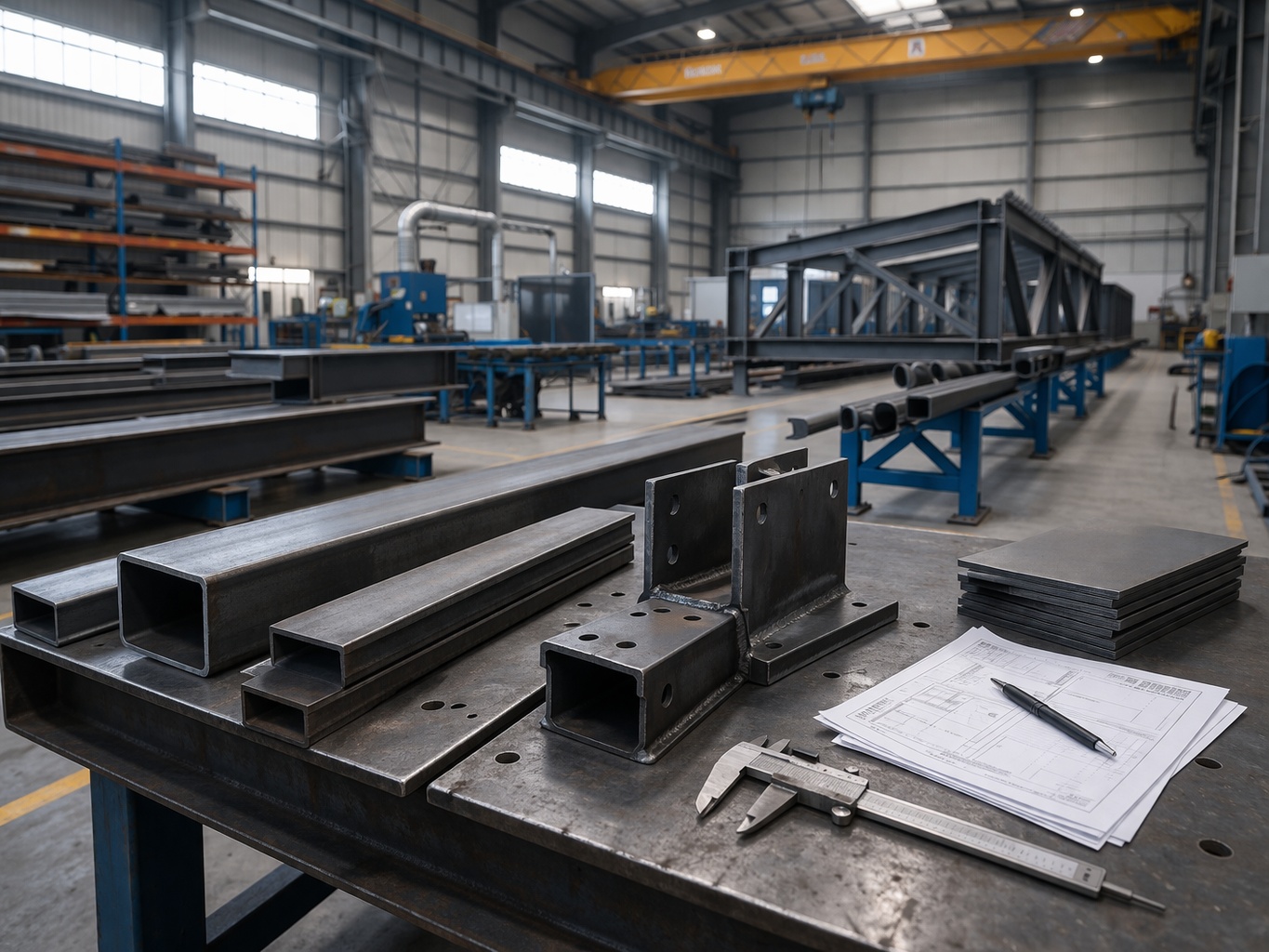
The manufacture of steel structures has long since ceased to rely solely on drawings, workshop techniques and the experience of the team. If a product is to be placed on the market as a construction product with a structural function, a whole range of requirements arises concerning conformity assessment, factory production control, documentation and marking. This is where EN 1090 comes into play. This standard does not replace design in accordance with Eurocode 3, but it regulates the manufacture and conformity of structural products placed on the market.
Most misunderstandings stem from two common misconceptions. The first is treating EN 1090 as a ‘company certificate’. The second is the assumption that, since a company is capable of welding and assembling steel to a high standard, the matter of compliance with the standard is settled. However, EN 1090 covers several areas at once: product scope, CE and DoP, FPC, execution classes, workshop requirements, welding, quality control and traceability. Only when all these elements are in place does the manufacturer have a solid basis for legally placing the product on the market.
What is EN 1090, and what is it not?
For steel structure manufacturers, two parts of the series are of paramount importance. EN 1090-1 remains the basis for assessing the conformity of the performance characteristics of steel and aluminium structural components and assemblies. EN 1090-2, on the other hand, specifies the technical requirements for the execution of steel structures. For manufacturers, it is precisely this distinction that is of the greatest importance: the first part concerns conformity and the market, whilst the second concerns actual production.
This must be clearly distinguished from the design process. Eurocode 3 is used for calculations, the selection of cross-sections, and checks on load-bearing capacity and stability. EN 1090 is one of the execution standards linked to the Eurocodes. The design therefore determines what is to be constructed and what its load-bearing parameters should be. EN 1090 determines how the component is to be manufactured, inspected, documented and declared as a construction product.
When does a product fall within the scope of EN 1090?
Not every steel product automatically falls within the scope of EN 1090-1. This standard applies when a component is to be permanently incorporated into a building structure and performs a structural function, meaning that its failure affects the mechanical resistance or stability of the structure. There is also a further restriction: if a more appropriate harmonised technical specification exists for a given product, that specification takes precedence as the basis for marking.
This distinction resolves many market disputes. Ordinary balustrades and fences, which merely prevent falls, are not automatically considered structural products under EN 1090-1 if they do not contribute to the load-bearing capacity or stability of the structure. On the other hand, the same type of product may fall within the scope of the standard if, in a given configuration, it performs a structural function. It is precisely the product’s function within the structure that is the decisive factor.
| Product or group of products | Does it usually fall within the scope of EN 1090-1? | What is the deciding factor? |
|---|---|---|
| beams, columns, bolts, bracing, steel joints | yes | the component is permanently installed and affects the load-bearing capacity or stability |
| construction kits supplied as a set | yes | the product serves a structural purpose within the building |
| standard balustrades and safety fences | not always | The mere presence of steel is not enough; what counts is its structural function |
| stairs or balustrades forming part of the load-bearing structure | often | a component failure affects mechanical strength or stability |
| specialist components covered by another relevant harmonised standard | not in accordance with EN 1090-1 | the dedicated specification takes precedence |
What does this table show?
The key point is this: it is not the material itself or the manufacturing process alone that determines whether a product falls within the scope of EN 1090. What matters is the product’s role within the structure and whether it is a construction product with a structural function. It is worth stating this distinction clearly, as this is precisely where misconceptions most often arise among manufacturers and clients.
The second issue concerns responsibility for interpretation. Many market-based studies attempt to broaden or narrow the scope of EN 1090 to suit commercial needs. The safest approach is to check the product’s function, its role within the structure, and whether there is a more appropriate standard for the product in question.
EN 1090-1: CE marking, Declaration of Performance and conformity assessment
From a market perspective, EN 1090-1 is not merely about the CE marking itself. It concerns a conformity assessment system designed to enable the preparation of a Declaration of Performance and the marking of the product in accordance with the Construction Products Regulation (CPR). Without a properly established conformity system, the product marking itself is of no value.
This shifts the focus from a one-off ‘documentation process’ to the maintenance of a repeatable system. After all, a manufacturer does not simply declare the quality of a single item for show; they must be able to consistently produce products with the declared properties. This is why EN 1090-1 is so closely linked to Factory Production Control and the supervision of a notified body.
Factory Production Control as the backbone of the production facility
Under the EN 1090 standard, it is not the conformity label itself that is most important for a manufacturer, but the FPC. The aim is to establish a system that confirms the manufacturer’s ability to maintain a consistent and controlled process. Consequently, it is not only the finished product that is assessed, but also the manufacturer’s capacity to produce it consistently.
At an organisational level, FPC encompasses much more than just the production hall. In practice, this includes contract review, staff competencies, welding, inspections and testing, material traceability, quality records and final product marking. This clearly illustrates that a facility may have a high level of technical expertise, yet still fail to pass the system smoothly if its documentation, order review or traceability are lacking.
| FPC area | What needs to work | Where does the problem most often arise? |
|---|---|---|
| contract review | verification of scope, requirements, EXC, and input documents | the order does not correspond to the actual scope of production |
| input materials | identification, compliance, delivery records | gaps in traceability or incomplete material documentation |
| manufacture and workshop assembly | procedures, sequence of operations, supervision | the discrepancy between procedure and practice in the hall |
| welding | qualifications, supervision, planning, enrolment | a lack of consistency between the WPS, staff and the scope of work |
| inspection and testing | checkpoints, results, approval | insufficient documentation or inconsistent criteria |
| product marking and final documentation | identification of the finished component, complete set of records | the element is implemented correctly, but poorly documented and difficult to reproduce |
This overview shows that the FPC does not function merely as a filing system for the auditor. It is a system designed to coordinate the day-to-day operations of the plant: from the receipt of raw materials to the dispatch of finished components. If a company treats the FPC solely as documentation to be presented, discrepancies between what is recorded and what is actually happening on the shop floor will very quickly arise.
It is equally important to note that many problems do not arise at the weld, but much earlier. A poorly conducted contract review, a lack of clear assignment of EXC requirements, or inconsistent material traceability can undermine the entire system, even when the fabrication and assembly themselves are carried out correctly.
EN 1090-2: the practical side of the standard
Whilst EN 1090-1 covers conformity and the market, EN 1090-2 covers the actual production of steel structures. This part specifies the technical requirements for the fabrication of steel structures. It covers the fabrication of both complete structures and steel components, and its scope includes materials, cutting, drilling, fitting, joints, welding, tolerances, surface protection, inspection and overall quality of workmanship.
For a manufacturing plant, this is the most important practical difference compared to the CPR itself. The CE marking and the Declaration of Performance (DoP) open up market access, but EN 1090-2 determines the standard of workmanship. This is precisely why it is not worth describing this standard as a mere administrative formality. For a manufacturing plant, it is a daily working standard that determines how workshop documentation is prepared, how the process is managed, and how the finished component is accepted.
EXC performance classes and their practical significance
One of the most important aspects of production is the EXC1–EXC4 execution classes. The higher the class, the stricter the requirements regarding execution, supervision and inspection. The working drawings should specify the relevant execution class or classes, as the entire level of requirements at the plant depends on this.
For a manufacturer, this is no small matter. The scope of the declared performance class directly determines which products the company can include in its system. This is no longer purely a technical decision, but also a business one. A class that is too low will not meet the project’s requirements. A class that is too high may unnecessarily raise organisational, control and cost requirements.
| Quality of workmanship | The nature of the requirements | Impact on the plant |
|---|---|---|
| EXC1 | the lowest level of rigour within the system | simpler requirements, but a limited range of applications |
| EXC2 | the level most commonly found in standard building structures | the standard benchmark for many record labels |
| EXC3 | higher standards of execution, monitoring and organisation | stricter requirements regarding welding, supervision and record-keeping |
| EXC4 | the highest standards | the company must be prepared for particularly demanding projects |
It’s worth taking your time to read this overview. The EXC designation isn’t a mark of prestige, but rather an indicator of the rigour of workmanship. A plant doesn’t gain anything from being ‘top-tier’ if its actual order book doesn’t require it. A sensible approach involves tailoring the system to the actual scope of production and market requirements.
The second important point concerns the basis for selecting the class. There are still many oversimplifications in circulation based on older materials. Under the current approach, the selection of the EXC class must be described in relation to the design documentation and current system rules, rather than as a simple table taken from a single section of the standard.
Welding, ISO 3834 and welding supervision
In the manufacture of steel structures, the discussion surrounding EN 1090 very quickly turns to welding. And rightly so, but only partly. Welded structures require EN 1090 to be combined with the EN ISO 3834 series. The level of quality requirements for welding depends on the execution class, and the process itself must be planned, supervised and documented.
For the plant, this means it must not only maintain a workforce of qualified welders and the necessary technology, but also ensure effective oversight of the process. A person is needed to be responsible for welding coordination, appropriate procedures, properly organised qualifications, equipment checks, and consistency between documentation and on-site practice. When a company treats welding purely as a production activity rather than a quality process, the EN 1090 system very quickly begins to fall apart.
Control, testing and traceability
Many manufacturers associate EN 1090 primarily with audits and welding, yet the ability to trace a product’s history is just as important. The input material, component marking, process sequence, inspection results, tests and final identification of the finished component together form a chain of evidence. Without it, the manufacturer has no solid basis for reliably confirming the conformity of their own product.
This is where the difference between ‘well-made steel’ and a compliance system comes into play. A component may be manufactured correctly in terms of geometry and technology, yet the company may still face difficulties during an assessment or in the event of a market dispute if it is unable to link the finished product to the material, the process and the inspection results. For manufacturers, this is one of the most underestimated aspects of EN 1090.
Where do companies most often go wrong?
The most common mistake is to reduce EN 1090 to the simple notion that ‘we have CE marking’. That is not enough. First, you need to establish whether the product actually falls within the scope of EN 1090-1. Then you need to maintain the FPC, select the appropriate EXC scope, carry out production in accordance with EN 1090-2, and, in the case of welded structures, ensure everything complies with the requirements of EN ISO 3834 and the competence of the personnel. Only such an arrangement makes technical and formal sense.
The second mistake is to confuse design with construction. The design is responsible for the structural solution, load-bearing capacity and calculation details. EN 1090 is responsible for the level of execution, inspection and conformity of the structural product. When these two aspects are confused, the plant begins to expect answers from EN 1090 that the standard simply does not provide, or conversely — attempts to resolve execution issues through the design alone.
What practical changes does EN 1090 bring to a fabrication plant’s operations?
When properly implemented, EN 1090 transforms a business in ways that go beyond what is usually assumed. It affects how orders are accepted, the review of input documentation, the selection of execution classes, the organisation of welding, staff supervision, material control, testing, product marking and the completeness of the final documentation. It is therefore not a standard that applies ‘at the end of the process’. It comes into play as early as the order preparation stage.
In the production of steel structures, EN 1090 does not begin with the CE mark. It begins with the question of whether the manufacturer truly understands what it is producing as a construction product, the scope of its operations, the execution class it adheres to, and whether it can demonstrate all of this honestly. If the answer is yes, the CE mark becomes the result of a well-organised system. If not, it remains nothing more than a sticker without any solid backing.
Sources:
https://single-market-economy.ec.europa.eu/sectors/construction/construction-products-regulation-cpr/frequently-asked-questions_en
https://knowledge.bsigroup.com/products/execution-of-steel-structures-and-aluminium-structures-requirements-for-conformity-assessment-of-structural-components
https://knowledge.bsigroup.com/products/execution-of-steel-structures-and-aluminium-structures-technical-requirements-for-steel-structures-2