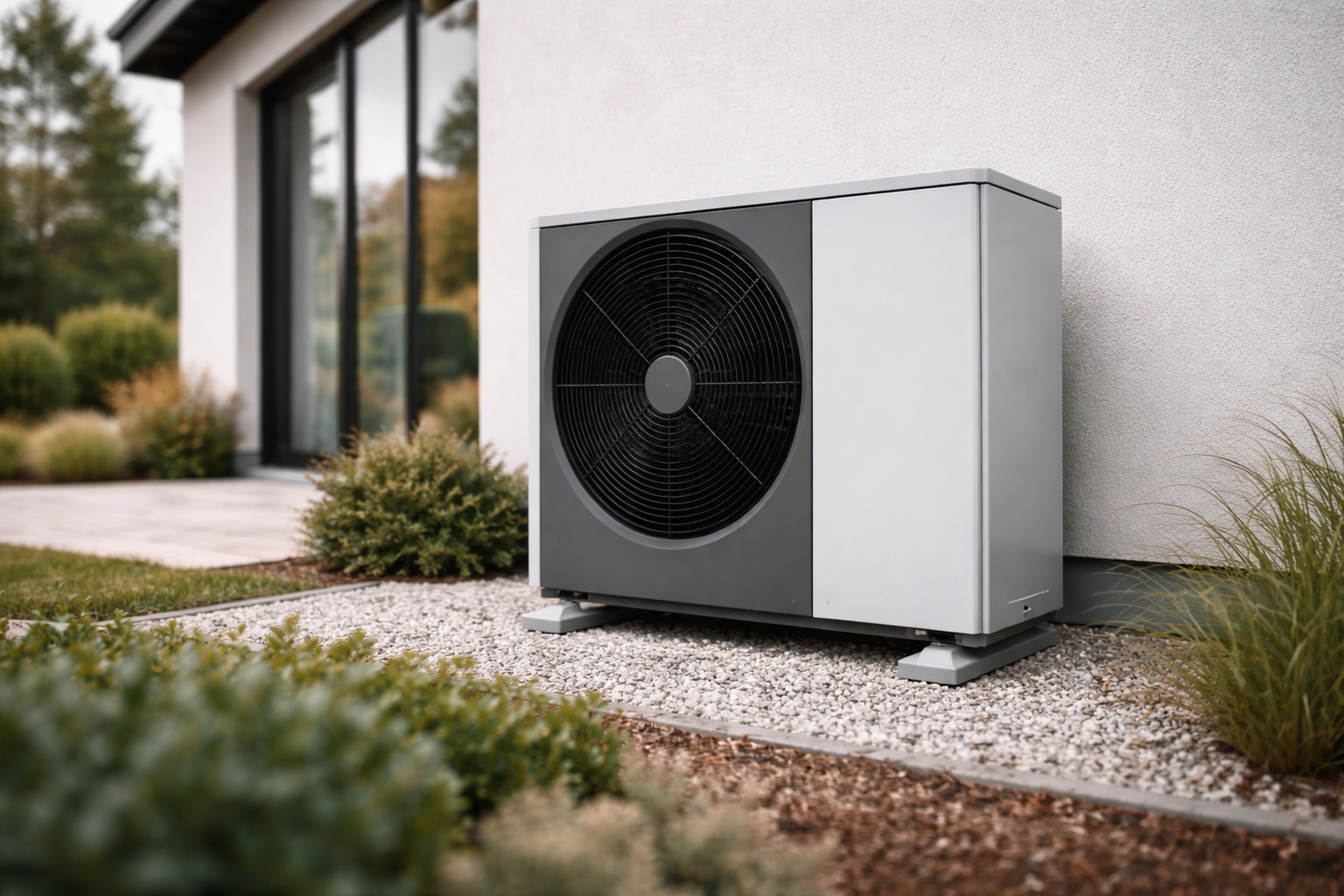
Should a heat pump run continuously? This is a question that comes up very often, but it is actually framed somewhat incorrectly. In practice, the issue isn’t whether the compressor should run non-stop 24 hours a day, but whether the entire system operates smoothly, stably and under conditions that are conducive to efficiency. For a heat pump, frequent switching on and off, excessively high supply temperatures, or attempts to heat the building up quickly after a significant drop in temperature overnight can be far worse than prolonged operation.
This is where the biggest misunderstanding lies. Many people judge a heat pump in the same way they used to judge a gas boiler: it’s supposed to start up quickly, bring the temperature up to the set level, and then switch off. The thing is, a heat pump usually works best in a different way. It prefers a low supply temperature, minimal temperature fluctuations within the building, a stable flow, and longer periods of operation with modulation. That is why the answer is not simply ‘yes’ or ‘no’, but rather: it should operate in such a way as to maintain the building’s temperature as evenly as possible, without unnecessary cycling.
Where does the belief come from that a pump shouldn’t run for long?
The root of the problem is usually a reliance on high-temperature heat sources. A boiler can raise the temperature in the system relatively quickly and, in many homes, copes well with aggressive heating schedules: heating more intensely in the morning, followed by a break, then heating up again in the evening. A heat pump works differently, because its efficiency drops when it has to operate at a higher setting and compensate for a large drop in the building’s temperature. The more the system is forced to react abruptly, the harder it is to maintain good efficiency.
As a result, many people interpret the pump running for long periods as a cause for concern, although this is very often a normal occurrence. If it is cold outside, the building has a certain level of heat loss, and the pump is operating at a low setting for most of the day, the system may run for a long time, and this is precisely when it is working correctly. It is not the fact that the compressor runs for a long time that is worrying. What is worrying is when it runs erratically, at too high a temperature, or without any noticeable improvement in comfort.
What does it actually mean when a heat pump is said to be ‘running all the time’?
In practice, three completely different situations need to be distinguished. The first is long, steady operation with power modulation. This is often the desired state, particularly in winter. The second is virtually continuous operation under high load, which may be normal during cold spells, but may also indicate that the system is operating at the limit of its capacity. The third is frequent starting and stopping of the compressor, i.e. cycling. This is usually the worst-case scenario.
Therefore, simply checking whether the outdoor unit is currently running does not tell us anything on its own. It is necessary to compare the operating time with the outdoor temperature, the supply temperature, the indoor temperature, the system’s behaviour and the heat load profile. The same observation – ‘the pump hardly ever switches off’ – could mean either exemplary operation on a cold day, or a poorly configured system that is trying to compensate for design flaws.
Why do heat pumps generally prefer to run for long periods without interruption?
The basic principle behind a heat pump is simple: the lower the supply temperature and the more stable the operating conditions, the easier it is to maintain a good COP and high seasonal efficiency. When the unit does not have to restart constantly, it does not waste energy on unnecessary start-up cycles and is not forced to rapidly ramp up its performance. This is precisely why weather-compensated control and the smooth maintenance of the temperature within the building generally work better than strict schedules with large changes in setpoint.
In modern inverter-controlled pumps, this is even more important. Such a system is not designed for simple on/off operation, but to modulate power output according to the building’s demand. If the building and the system allow heat to be transferred at a low flow temperature, the pump can operate at partial load for long periods. This is usually a more natural operating condition for it than short, intense cycles.
When is working long hours considered normal?
The most common scenario is the heating season when outdoor temperatures are lower. If the heat pump maintains a stable temperature in the house, operates at a reasonable flow rate and there are no sudden fluctuations, prolonged operation is normal. Under such conditions, the building experiences constant heat loss, so the heat pump simply compensates for it. With a well-calibrated weather compensation system and a low-temperature installation, this mode is often the most efficient.
The situation is similar in systems where the pump is not selected to meet the absolute peak demand exactly, but is designed to cover most of the season and is expected to operate for a long time. In practice, many manufacturers and designers do not select a pump so that it can handle every possible hour of winter on its own with a large margin. It is often selected to cover a significant part of the season as efficiently as possible, even if this means a longer operating time. In this logic, the operating time itself is not a sign of overload, but a normal characteristic of a low-temperature source.
| Observation | What could this mean? | Is that normal? | What to check |
|---|---|---|---|
| Working for long periods in the cold | standard coverage of building losses | usually, yes | supply temperature and room temperature |
| Long-lasting performance with consistent comfort and low power consumption | smooth, trouble-free operation of the system | yes | is there any overclocking |
| The boiler has been running for a long time without the house reaching the desired temperature | a potential issue with the power supply, settings or installation | not always | pump capacity, curve, consumers, flow |
| Prolonged operation at above-freezing temperatures and high power input | either the curve is too steep or there is a problem with the installation | often not | weather station settings and receiver size |
The most important point to take away from this comparison is quite simple. Operating time alone is not a diagnosis. The pump’s operation must be considered in the context of outdoor temperatures, the supply water temperature, and whether the building achieves the desired level of comfort without the compressor running erratically.
When can working non-stop be a problem?
Prolonged operation becomes a cause for concern when the pump runs continuously but is still unable to maintain the temperature in the building, or when it has to operate at too high a setting for most of the time. If, in mild weather, the flow rate is high and the system still ‘runs’ endlessly, this usually means that something is incorrectly set or poorly selected. The problem may lie in the heating curve, the flow rate, undersized radiators, insufficient pump power, or hydraulic faults.
The situation is similar when the pump spends a long time trying to restore the temperature after a significant drop overnight. In such cases, what appears to be ‘hard work’ is not a sign of good modulation, but rather the result of a poor control strategy. The building has become cold, so in the morning the system has to work harder and usually at a lower efficiency than would be required under stable temperature conditions. This is one of the most common reasons why users get the impression that the pump “runs all the time and achieves nothing”.
The biggest enemy of a heat pump: cycling
Far worse than prolonged operation is cycling – that is, frequently starting and stopping the compressor in short cycles. It is this mode of operation that most often compromises seasonal efficiency, increases mechanical wear and makes it difficult to maintain a stable level of comfort. From the heat pump’s perspective, it is far better to run for a long time at low power than to start and stop unnecessarily every few minutes.
In practice, many people regard throttling as ‘normal’, as the device seems to be taking frequent breaks. However, from a technical point of view, this is usually a sign that the system is unable to find a stable operating point. The cause may be that the pump’s power is too high relative to the current load, the water capacity is too low, the flow rate is too low, the circuits are excessively restricted, or the heating curve is set incorrectly.
What is the most common cause of clocking issues?
The most common cause is oversizing. If the pump, even at minimum modulation, delivers more heat than the building needs at any given moment, the compressor has nowhere to ‘send’ this energy. The temperature rises rapidly, the system switches off, starts up again after a short while, and the cycle repeats. This is particularly common during transitional periods when the demand for heat is low.
The second cause of the problem is the system’s hydraulics. Insufficient flow, too many closed loops, aggressive thermostatic heads, or zoning that cuts off a significant proportion of the loads can prevent the pump from operating under stable conditions. In such cases, even a well-selected unit begins to perform poorly, as the system is unable to absorb heat at the specified flow rate and temperature.
| Reason | What happens in the system | Effect on pump performance | A typical solution |
|---|---|---|---|
| An oversized pump | the minimum power is still too high | short cycles and frequent starts | better selection, control adjustment, sometimes a buffer |
| Flow rate too low | the pump is unable to dissipate heat effectively | rapid temperature rises and shutdowns | hydraulic system adjustment, opening of circuits |
| Too many restricted areas | the system’s heat absorption is decreasing | timing, despite the good weather | simplifying control, ensuring minimum flow |
| The heating curve is too high | the system reaches the hold temperature too quickly | shorter cycles and reduced efficiency | flattening the curve, stabilising operations |
One important point emerges from this table. Pulsation is rarely an inherent ‘feature’ of a heat pump as such. It is usually the result of the unit being poorly matched to the system or of poor operating conditions. This is good news, as some of the problems can be mitigated without replacing the entire heat pump, provided the hydraulics and controls are improved.
Power modulation – why does the inverter change its operating mode?
Inverter pumps are specifically designed to adjust their power output to the current load. This means they do not have to operate solely in a ‘full power or complete stop’ mode. They can reduce their output and maintain continuous operation for longer periods under partial load. This is a huge improvement over older on/off systems.
However, it is important to remember that every modulation has its lower limit. Even a very good inverter pump has a minimum output below which it cannot go. If the building requires even less at any given moment, the system will still start cycling. Therefore, the mere presence of an inverter does not solve everything. You still need sensible selection, proper installation and a good heating curve.
The heating curve and weather data – this is often what determines the quality of the work
Weather-compensated control is one of the most important factors in ensuring a heat pump operates correctly. The principle behind it is that the supply temperature is adjusted to match the outside temperature and the building’s actual heat loss. When it gets colder outside, the system slightly increases the temperature setting. When it gets warmer, it lowers it. This means the pump does not have to run at an excessively high temperature ‘just in case’.
An incorrectly set heating curve can compromise efficiency even in a well-designed system. If it is too steep, the pump operates at too high a setting, which reduces the COP and increases the risk of cycling. If it is too low, the building does not achieve the desired comfort level and the user begins to manually raise the settings or aggressively adjust the schedule. In practice, many problems attributed to a ‘poor pump’ actually stem from incorrect weather compensation settings.
A drop in temperature at night – when does it help, and when does it hinder?
This is one of the most practical topics. A slight setback – that is, a slight drop in temperature – can make sense. The problem arises with large night-time reductions or when the heating is switched off completely. Then, in the morning, the building is noticeably cooler and the pump has to make up for the losses, often at a higher supply temperature. This usually works against efficiency rather than in its favour.
This is precisely why, for heat pumps, it is generally recommended to maintain a more stable temperature with minor adjustments rather than the strict schedules typical of boilers. The smaller the fluctuations in indoor temperature, the easier it is to maintain smooth operation, lower operating parameters and higher seasonal efficiency. This does not mean that every reduction is a mistake. It simply means that large fluctuations usually do more harm than good.
| Operating mode | Comfort | Impact on performance | When does it make sense? |
|---|---|---|---|
| Constant temperature | very stable | usually favourable | the typical operating mode for a properly adjusted pump |
| A minor setback | still stable | generally acceptable | when a slight touch-up is needed, whether at night or during the day |
| A major setback | greater fluctuations | often unfavourable | less frequently, only when steering very deliberately |
| Switching off the central heating completely at night | low stability | usually poor for a heat pump | as a rule, this isn’t the best strategy |
From the point of view of the compressor’s operation, it is usually best to keep the building as stable as possible, rather than constantly cooling and heating it. This is what distinguishes heat pumps from high-temperature heat sources.
The pump alone isn’t enough – it’s the whole system that counts
The pump’s operating mode depends not only on the pump itself, but also on the heat consumers. If the system requires a high flow temperature – because the radiators are small or the building has high heat loss – the pump has to operate under less favourable conditions. If the system has underfloor heating or suitably large radiators and a well-calculated flow rate, it is much easier to maintain a low-temperature, smooth operating mode.
This explains why the same heat pump can perform very well in one house and significantly less well in another. It is not a question of the ‘nature of the device’, but rather whether the entire system has been designed for a low-temperature heat source. If the installation demands high performance, the heat pump ends up fighting against the building’s physics, rather than operating within its natural range.
Buffer, flow and open circuits
The subject of buffers is often oversimplified. A buffer is not a universal solution to all problems, but in certain setups it helps to increase water capacity, stabilise flow and reduce pulsation. However, it should not be treated as a magic fix for a poorly designed system. If the hydraulics and controls are flawed, a buffer alone will not fix the entire system.
It is far more important that the pump is guaranteed a minimum flow rate and that the system does not shut down too abruptly upstream of it. In many cases, stable operation depends more on a simple, predictable circuit than on adding further intermediate components. This is one of the reasons why heat pumps often perform best in simple, weather-compensated systems without excessive zoning.
DHW is a separate operating mode
You should also not confuse the building’s heating system with the domestic hot water system. When heating domestic hot water, the pump usually operates at a higher temperature than when heating the central heating system, so the unit may behave differently: it may be noisier, run more intensely, or be more noticeable to the user. This does not necessarily indicate a problem. It is simply a different operating mode.
The time of day when hot water is prepared is also significant. If this cycle takes place during the coldest hours of the night, the pump operates under less favourable conditions. Sometimes this is done deliberately to take advantage of a specific tariff, but if there is no such reason, it is worth looking at the schedule more broadly, rather than just focusing on the price of energy during a single hour.
How can you tell if the pump is working properly?
The best indication that everything is working properly is simple: the house stays consistently warm, the supply temperature isn’t excessively high, and the compressor doesn’t cycle on and off every few minutes. The system doesn’t need to be completely silent or ‘invisible’. A heat pump that’s working well often means that, for most of the season, the unit simply runs quietly and continuously.
Poor performance usually manifests itself in the opposite way: high supply temperatures in mild weather, significant temperature fluctuations indoors, frequent compressor starts, sharp drops in temperature at night, and the impression that the system is constantly playing catch-up. In such cases, the problem is often not the pump itself, but the way it has been integrated into the building and the control system.
Summary
Should a heat pump run continuously? Not in the literal sense of running non-stop without ever stopping, but it should very often run for long periods, smoothly and with modulation, rather than starting and stopping unnecessarily. It is precisely this mode of operation that usually best promotes efficiency, comfort and the longevity of the compressor.
The worst approach is to think of a heat pump as a boiler. A properly configured heat pump should not have to ‘chase’ the temperature after significant drops, but should maintain a stable temperature in the building at the lowest possible setting. That is why the most important question is not whether it runs all the time, but whether it runs correctly: without unnecessary cycling, with a well-calibrated weather compensation system, correct flow rates, and an installation that is actually suitable for a low-temperature heat source.
FAQ – Should a heat pump run continuously?
Yes, and in winter this is often the norm. However, this does not mean running ‘at full throttle’, but rather long, steady heating with power modulation and a low flow temperature.
Usually not. If the unit frequently starts and stops in short cycles, this usually indicates cycling, which typically reduces efficiency and puts a strain on the compressor.
In many homes, no. A significant drop in temperature overnight often means that in the morning the heat pump has to work harder and at a higher setting to restore the building’s temperature.
The best sign is simple: the house is consistently warm, and the pump isn’t cycling every few minutes. Long running times aren’t a problem in themselves, provided the system maintains comfort without sudden temperature fluctuations.
Most often, these are an incorrect heating curve, insufficient flow, circuits that close too frequently, and an incorrectly selected unit capacity. Often, the problem is not the pump itself, but the hydraulic and control system in which it has been installed.
Sources:
https://www.daikin.co.uk/en_gb/residential/inspiration/articles/why-heat-pumps-go-wrong.html
https://www.heatpumps.org.uk/wp-content/uploads/2024/11/Heat-pump-controls-guide-FINAL.pdf