
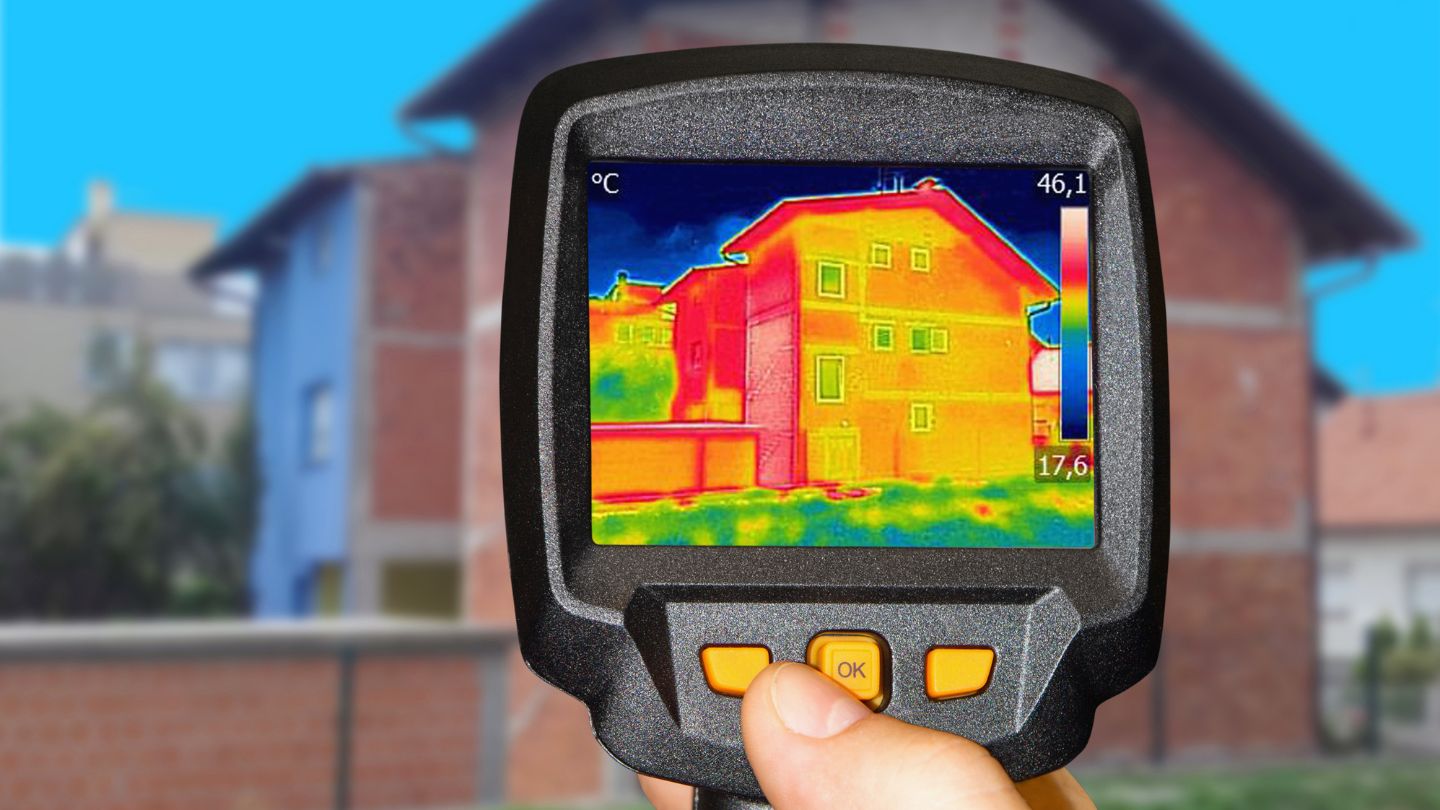
Thermal bridges in commercial and office buildings are not a minor issue. In buildings with large façade areas, complex structural connections, extensive service zones and high comfort requirements, even localised breaks in the continuity of the insulation can result in significant energy losses, lower internal surface temperatures and operational problems. Modern requirements for building envelopes increasingly treat thermal bridges as a separate element of assessment, rather than merely a minor detail of the design.
In an office or commercial building, the problem does not end with the heat balance alone. A thermal bridge can alter local conditions at the façade, increase the risk of condensation, reduce the durability of the finish and make it difficult to maintain stable operating conditions for the HVAC system. The more refined the partition areas are, the greater the importance of joints, edges, fixings and transition zones between systems.
What is a thermal bridge and why is it so important in office buildings?
A thermal bridge is a point where heat transfer through a building envelope increases locally. This usually occurs for three reasons: a change in the geometry of the partition, the presence of a material with higher thermal conductivity, or a break or weakening in the continuity of the insulation layer. In more modern building envelope standards, a distinction is made between linear and point thermal bridges. Linear thermal bridges include, for example, the edges of ceilings, parapets, roof-to-wall junctions, façade-to-structure interfaces, and joinery interfaces. Point thermal bridges relate to individual elements penetrating the insulation.
In commercial and office buildings, there are simply far more of these areas than in a simple, compact building. Mullion-and-transom façades, recesses, service areas, equipment cantilevers, connectors, service balustrades, service platforms and extensive roof connections form a dense network of details where additional heat transfer can easily occur. A single thermal bridge may seem harmless, but on the scale of the entire building, the sum of these points begins to have a real impact on its performance.
How do thermal bridges affect a building’s energy balance?
The simplest mechanism is this: heat escapes more quickly through a thermal bridge than through a properly designed building envelope. In winter, this increases heat loss; in summer, it can increase the cooling load, particularly on facades that are heavily exposed to sunlight and have complex designs. In a building where the walls, roof and joinery already have good performance, the proportion of heat loss associated with joints and details becomes proportionally greater. That is why it is not enough to know the U-value for the partition itself. One must also understand what happens at the junctions between elements.
In office buildings, the consequences go beyond simply higher energy consumption. Localised cooling of areas near the façade affects workplace comfort, may lead to increased user complaints, and, in the case of heavily glazed façades, makes it difficult to maintain uniform indoor conditions throughout the entire depth of the room. This, in turn, affects the operation of heating and cooling systems, which must compensate for the building’s non-uniform envelope.
Where are thermal bridges most commonly found in office buildings?
The most vulnerable areas are the junctions. The edge of a floor slab where it meets the façade is a classic example of a thermal bridge. Parapets, the junctions between the roof and the wall, the areas around mullion-and-transom façades, sunshade fixings, brackets for technical equipment, and the points where joinery and shop windows are fitted all work in a similar way. The more structural or installation elements that penetrate the insulation layer, the greater the risk of additional heat transfer.
In commercial buildings, the problem often stems not from a single glaring error, but from an accumulation of minor weaknesses. A single detail on the façade may be correct. So may a single bracket. The same goes for a single service duct. However, when there are hundreds of such points, the issue ceases to be a localised one. It begins to shape the thermal performance of the entire building.
| Space in the housing | Bridge type | Energy efficiency | Additional risk |
|---|---|---|---|
| the edge of the floor slab at the façade | linear | increased heat loss at the junction between the ceiling and the façade | reduction in surface temperature on the façade |
| parapet and the junction between the roof and the wall | linear | additional heat loss through the roof area | the risk of the upper sections of the partition becoming cold |
| area for fitting joinery and display cabinets | linear | a deterioration in the actual glazing balance | dampness on the façade, condensation on the window frames |
| brackets, connectors, cover fixings | point or line | localised insulation failure | moisture and greater difficulty in refining the details |
| cable entries through the housing | point-based | additional damage and disruption to the continuity of the layers | leaks and the risk of operational errors |
This table clearly shows that, in office buildings, thermal bridges are usually inherent in the very complexity of the architecture and technology, rather than being solely down to the quality of a single material. The more elaborate the façade, the more technical zones there are, and the greater the number of structural connections, the more important the details become.
This also explains why two buildings with similar U-values for their walls may perform differently in terms of energy efficiency. The U-value of the building envelope alone does not indicate how much energy is lost through joints, edges and installation points.
Where do thermal bridges come from?
The first source of the problem is the geometry. Every bend, corner, edge or transition point between partitions alters the conditions of heat flow. The second source is the material. If steel, aluminium or another highly conductive material passes through the insulation layer, the local heat flux increases even when the rest of the system is designed correctly. The third source is the construction detail: broken insulation, poorly fitted joinery, imprecise system connections or a lack of continuity in the layers.
In commercial buildings, these three mechanisms often overlap. The junction between the ceiling and the façade is a good example: there is a change in geometry, structural elements are present, and at the same time it is a detail that is difficult to refine on site. This is precisely why thermal bridges must be addressed not only in terms of materials but also conceptually, right from the design stage of the junction.
Thermal bridges and condensation and the durability of the partition
A thermal bridge lowers the temperature of the internal surface. If this temperature drops sufficiently, there is a risk of surface condensation or intermittent dampness. This is no longer merely a matter of heat loss. It concerns the durability of the partition and the hygrothermal conditions inside the building. A cooler zone near the façade or in a corner can lead to soiling, dampness in the finishes, and, in extreme cases, to the growth of mould.
In an office or commercial premises, the effects become apparent very quickly. Users report draughts coming from the façade; a chill can be felt near the partition wall despite the room’s average temperature being correct, and the heating system has to work harder to maintain a comfortable environment. This is precisely the moment when a thermal bridge ceases to be a theoretical problem.
Facades, joinery and ceiling joints – three critical areas
Facades present the greatest challenge. In modern office buildings, they contain the greatest number of interfaces between the structure, glass, profiles, fasteners and insulation layers. Every fixing, every bolt, every point where systems meet can create an additional pathway for heat transfer.
The second critical area is the joinery and its installation. Even a good window or display window loses some of its potential if the thermal connection to the building envelope is poor. The problem is not just the frame, but the entire installation area: window sills, lintels, reveals and the connection to the insulation layer.
The third area concerns the junctions between ceilings and the façade, roofs and walls, and any parapets. These are places where it is very easy for a linear thermal bridge to form, extending across a large part of the building’s perimeter. High heat loss from a single metre of this can have a significant impact on a large building.
Why isn’t a good U-value alone enough?
This is one of the most common misconceptions regarding a building’s envelope. The U-value describes the area of a building element, but does not account for the full extent of heat loss resulting from joints and penetrations. A building may have excellent walls, a roof and windows, yet still achieve a poorer energy performance if the detailing is poor. This is precisely why thermal bridges must be considered separately and included in the calculations for the entire building.
The better the building envelope itself is, the more significant the areas that compromise its quality locally become. In an average building, thermal bridges tend to be ‘masked’ by the generally poor performance of the structure as a whole. In a modern building, they become much more noticeable, as the contrast between the high-quality envelope and the poor-quality details is greater.
How are thermal bridges minimised at the design stage?
The first step is ensuring the continuity of the insulation. The second is to design connections deliberately, rather than adding details as an afterthought. The third is to limit penetrations through the building envelope and to select installation methods that minimise contact between highly conductive materials and the outer layer. In buildings with more sophisticated energy efficiency, intuition is no longer enough. Vulnerable areas need to be modelled and calculated, rather than simply ‘judged by eye’.
Interdisciplinary coordination is equally important. The architect, structural engineer, façade designer and services engineers must all work on the same detailed drawings. Some gaps arise not because someone chose the wrong material, but because each discipline developed its own section separately, and the whole was not checked as a single system.
What does this mean for investors, designers and contractors?
For the investor, thermal bridges mean more than just a poorer rating in an energy performance certificate or model. They mean potentially higher running costs, greater susceptibility to façade problems, and a more difficult-to-maintain indoor environment. For the designer, it is a duty to refine not only the partition surfaces but also all the joints. For the contractor, it is a matter of detail quality, the sequence of works and maintaining the continuity of layers in places that are easiest to overlook.
This is precisely why thermal bridges in commercial and office buildings must be treated as an issue that cuts across building services engineering, building physics and user comfort. It is not simply a matter of the cross-section’s appearance. It is one of the prerequisites for ensuring that a building performs as intended.
Summary
Thermal bridges in commercial and office buildings affect energy loss, façade comfort, the risk of condensation and the durability of the building envelope. The more technologically advanced the building envelope and the better the performance of the envelope itself, the greater the importance of the connections and details. In a well-designed building, thermal bridges are not an afterthought in the energy balance. They are an integral part of it.
FAQ – Thermal bridges
It is a point where heat flows more quickly than through the rest of the partition. This is most often due to the geometry of the joint, a breach in the insulation, or the presence of a highly conductive material.
Most commonly at the edges of ceilings, parapets, façades, joinery installation areas, corbels and service penetrations. Connections between different systems are particularly problematic.
Yes, because they increase actual heat loss in winter and can worsen the cooling balance in summer. In large buildings, the total of such losses can be significant on a building-wide scale.
It can, if it lowers the surface temperature enough to cause condensation or persistent dampness. Initially, you usually see dirt and localised cooling, and later biological problems may arise.
It is necessary to ensure the continuity of insulation, well-designed connections and a reduction in penetrations through the building envelope. In more demanding buildings, it is also necessary to model thermal bridges and take them into account in the thermal balance.