
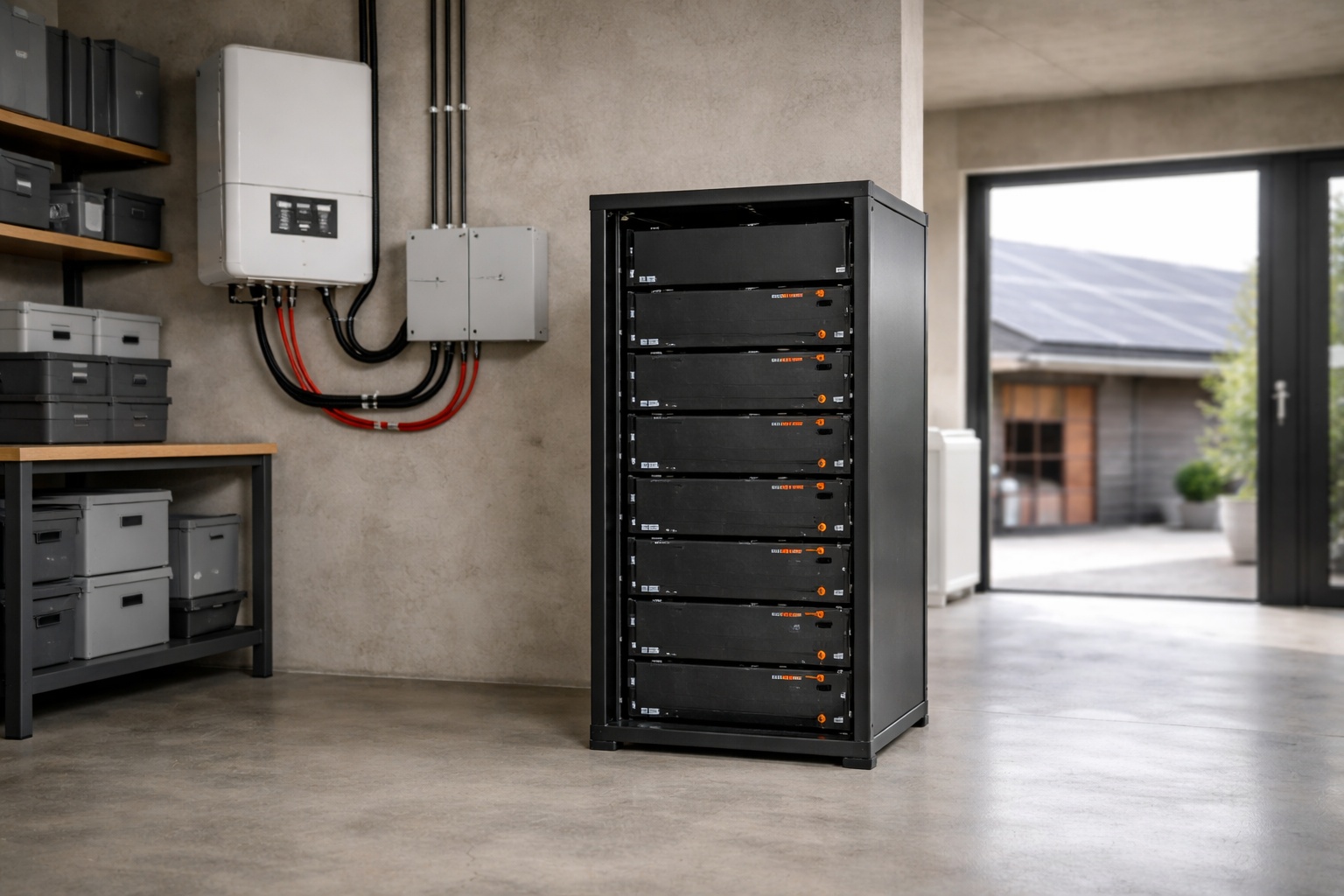
The Pylontech US5000 is one of the most recognisable 48 V battery modules on the energy storage market. The manufacturer positions it as a 4.8 kWh modular LFP battery for ESS systems, emphasising its ease of expansion and broad compatibility with inverters. However, this is not a battery that should be judged solely by the number of kWh on the label. With the US5000, just as important as capacity are the 48 V architecture, DC currents, battery group limits and how the entire system interacts with a specific inverter.
In reality, the US5000 performs well where modularity, phased expansion and operation in a common low-voltage environment are key. For small and medium-scale applications, this is a major advantage. With larger systems, however, the classic 48 V problem arises: increasing currents, greater demands on cabling, protection devices and the organisation of the DC side. Therefore, the question of this model’s scalability must be considered not only in terms of ‘how many modules can be connected’, but also ‘whether such a scale still makes technical sense’.
What is the Pylontech US5000 and what is its market positioning?
The US5000 belongs to Pylontech’s low-voltage energy storage series and is an extension of the well-known 48 V range, which is mainly used in domestic systems, backup systems and small commercial installations. The official product website describes it as the latest 48 V LFP battery with a higher capacity of 4.8 kWh and greater resistance to current loads. In the US5000 series manual, the manufacturer also clearly states that this is a 48 V solution with its own BMS.
This distinction is important. The US5000 is not a high-voltage rack unit designed for traditional large-scale C&I systems; It is a low-voltage ESS module that can be scaled up significantly in terms of power, but which still operates on a 48 V system. This makes it highly flexible within its class. And on a larger scale, it needs to be viewed differently from a typical module ‘for a home with solar panels’.
Specifications of a single module
The key specifications for a single module are quite clear. The US5000 series manual specifies a rated voltage of 48 VDC, a nominal capacity of 4800 Wh and a usable capacity of 4560 Wh for the US5000 and US5000-B. The depth of discharge is specified as 95%, and the documentation also clearly states that all information for the US5000 also applies to the US5000-B.
Experience shows that this means a single module provides around 4.56 kWh of usable energy. This is a good result for a 48 V battery in a standard 19″ rack, but on its own it says nothing about the scale of the entire system. To assess the practicality of this battery, one must immediately compare its capacity with the currents, operating voltage and limitations of the entire battery bank.
| Parameter | Value |
|---|---|
| Cell chemistry | LFP / Li-ion (LiFePO₄) |
| Rated voltage | 48 V |
| Nominal capacity | 4.8 kWh / 100 Ah |
| Net capacity | 4.56 kWh / 95 Ah |
| DoD | 95% |
| Recommended charging/discharging current | 80 A |
| Maximum number of modules in a single group | 16 |
| Charging voltage range | 52.5–53.5 V |
| Discharge voltage range | 43.5–53.5 V |
| Communication | RS485, CAN |
| Protection class | IP20 |
| Dimensions | 442 × 420 × 161 mm |
| Weight | approx. 39.7 kg |
This set of specifications highlights two key points. Firstly, the US5000 is a significantly larger module than older 48 V batteries with a capacity of 2.4–3.5 kWh. It is therefore easier to build systems with a reasonable capacity using it without having to increase the number of modules. Secondly, it remains a low-voltage architecture. This means that as capacity increases, so too does the significance of currents, the number of cables and the quality of the entire DC-side integration.
Net capacity and actual energy output of the system
One of the most common mistakes when assessing this battery is confusing the nominal capacity with the actual available energy. Pylontech states a nominal capacity of 4.8 kWh, but the usable capacity of a single module is 4.56 kWh. This is not a minor difference, as in larger systems it begins to make a noticeable difference in calculations of runtime and storage balance.
It works out that two modules provide 9.12 kWh of usable capacity, four provide 18.24 kWh, eight provide 36.48 kWh, and sixteen provide 72.96 kWh. Even with just a few modules, it is clear that the US5000 is not just a ‘small backup battery’. However, it can provide very sensible capacity for a home, a larger home with a heat pump, light commercial use or a small off-grid system.
| Number of modules | Nominal capacity | Net capacity |
|---|---|---|
| 2 | 9.6 kWh | 9.12 kWh |
| 4 | 19.2 kWh | 18.24 kWh |
| 8 | 38.4 kWh | 36.48 kWh |
| 16 | 76.8 kWh | 72.96 kWh |
Interpreting this table is fairly straightforward. In terms of power, the system scales very conveniently and linearly, so from the end-user’s perspective, the US5000 is an ideal module for phased expansion. The problem arises not in terms of kWh, but rather when it comes to managing increasing power and current levels within a 48 V low-voltage environment.
LFP lifespan and chemistry
The US5000 uses LFP chemistry, which immediately makes it well-suited for stationary applications. The technical data sheets and product documentation for this range consistently state a lifespan of over 6,000 cycles and more than 15 years of operation at a reference temperature of 25°C. From a home ESS perspective, these figures correspond to a class of products designed for many years of cyclic operation.
However, these figures must be interpreted sensibly. They do not guarantee identical results in every installation. Actual service life depends on operating temperature, the number of charge cycles, the current load, the quality of interaction with the inverter, and the overall charging and discharging logic. A well-designed system using the US5000 can operate reliably for a long time. A poorly organised 48 V system can shorten the lifespan of the entire system, despite the battery’s own catalogue specifications being correct.
Scaling without LV-HUB
The manufacturer allows a maximum of 16 modules in a single standard battery pack. This gives a nominal capacity of 76.8 kWh and a usable capacity of approximately 72.96 kWh. From a domestic perspective, this is already a very large storage capacity. The same applies from the perspective of a small business or light commercial use. In this respect, the US5000 remains relatively straightforward to understand and implement, provided the inverter and cabling are selected to suit this configuration.
It is worth noting, however, that at this stage we are no longer talking about ‘a few batteries under the stairs’, but about a fully-fledged low-voltage system with a significant energy capacity. With 16 modules, the parameters of a single block alone cease to be the only factor. Cable cross-sections, safety devices, cabling routes and the limitations of the inverter itself become increasingly important. This is the point at which a simple home storage system begins to evolve into a more sophisticated DC system.
Scaling with LV-HUB
If the system is to consist of more than 16 modules, the manufacturer recommends using an LV-HUB. The documentation for this device describes it as a CAN communication hub for multiple parallel groups of 48 V battery piles. The LV-HUB manual states that a single hub can connect up to six battery piles, and each such group can have up to 16 modules compatible with the US5000 series. This gives a total of up to 96 modules in a single larger system.
When converted into energy, this makes for a very large system: 460.8 kWh nominal and approximately 437.76 kWh usable. This shows that, in terms of capacity alone, Pylontech allows you to go a very long way. At the same time, this is precisely the point at which one must no longer think of the US5000 as simply a ‘home battery system scaled up to include more units’. On this scale, the entire setup requires a much more systematic approach.
| System variant | Number of modules | Nominal capacity | Net capacity |
|---|---|---|---|
| A small system | 4 | 19.2 kWh | 18.24 kWh |
| Medium-sized system | 8 | 38.4 kWh | 36.48 kWh |
| Max. one group | 16 | 76.8 kWh | 72.96 kWh |
| Max. from LV-HUB | 96 | 460.8 kWh | 437.76 kWh |
Such a table looks impressive, but this is precisely where one must be most careful to distinguish between the technical specifications and the practicalities of implementation. From a technical standpoint, the figures are impressive. Technically, however, we are still talking about a 48 V system, which, on this scale, requires very careful design in terms of DC, communication and safety. It is not a natural competitor to a containerised HV ESS in every situation. It is a complex low-voltage storage system that only makes sense when the system architecture truly justifies it.
The main limitation: it is still a 48 V system
This is the crux of the matter. 48 V is ideal when the system needs to be simple, widely adopted, easy to expand and compatible with a broad range of off-grid and hybrid inverters. This is precisely what has made the US series so successful. However, this very same voltage becomes a limitation when the investor seeks to achieve very high power output or operate on a very large scale.
At low voltages, currents increase, and with them the demands placed on cables, busbars, protective devices and the organisation of the entire BOS. The larger the system, the less sense it makes to look solely at the total kWh. At some point, it is no longer capacity that matters most, but whether the DC side remains reasonable and whether the entire system is becoming unnecessarily complex to install compared to a high-voltage system.
This is precisely why the US5000 works very well with a few to a dozen or so modules, whereas with very large configurations, one has to ask honestly whether this is still the best architecture. Scalability is possible, but that does not automatically mean that every scale is equally sensible from a design perspective.
Inverter compatibility and communication
One of Pylontech’s greatest strengths is its broad compatibility with the inverter market. The official compatibility list for low-voltage ESS dated August 2025 shows the US5000 and US5000-B working with numerous brands and series of inverters, in both on-grid and on/off-grid modes. The document includes, amongst others, Victron, Solis, Deye/Sunsynk, Lux Power, Growatt, Sol-Ark, Sungrow, TBB, MEGAREVO, Afore and many others. In practice, this means great design flexibility and is one of the reasons for this battery’s popularity.
At the same time, caution is required. Compatibility does not mean complete freedom. The list specifies particular models, specific communication protocols and specific firmware versions. In a real-world project, you need to check not only the inverter brand, but also its exact version, communication method, current limits and whether the configuration in question is actually supported by both parties. With a larger number of modules, the inverter very often becomes a real limitation of the system, even if the battery itself could be further expanded.
Pylontech US5000 and US5000-B
There are documents in circulation for both the US5000 and the US5000-B, which can cause some confusion. The US5000 series manual explains this quite clearly: unless otherwise stated, information regarding the US5000 also applies to the US5000-B. At the same time, the document highlights certain hardware differences, such as the presence of a switch in the US5000-B. This means that when working on a new project, one should not automatically assume that every PDF describes exactly the same product revision.
From a practical point of view, it is best to check four things at once: the full model designation, the current manual, the compatibility list and the inverter’s specifications. In a small installation, such details may seem secondary. In a larger setup, however, they can determine whether the project will be straightforward and predictable, or whether it will end up relying on assumptions drawn from different versions of the documentation.
Where does the Pylontech US5000 make the most sense?
The most natural applications include single-family homes with PV and a hybrid inverter, larger homes with a backup system, off-grid or semi-off-grid systems, small businesses, and light commercial premises, where modularity and easy phased expansion are key. In such scenarios, the 48 V architecture remains an advantage, and broad compatibility with inverters facilitates design and subsequent servicing.
The US5000 makes the least sense when someone tries to use it to build a very large energy storage system and focuses solely on total capacity. In terms of energy capacity, it is possible to achieve a high level. System-wise, however, the question arises as to whether it is still worth maintaining the whole system at 48 V. Would it not be better to switch to a high-voltage architecture or a ready-made ESS cabinet? This is not a criticism of the product itself. It is simply an honest recognition of the limit at which the advantages of the US series gradually begin to turn into limitations.
| Script | Does the US5000 make sense? | Why? |
|---|---|---|
| A house with solar panels | absolutely | A simple, modular 48 V system fits well into such a setup |
| A bigger house with a backup | yes | easy to scale up in stages |
| Small business | yes | adequate capacity and high inverter compatibility |
| Light commercial | conditionally yes | It works, but you need to keep an eye on the DC side and the inverter’s limitations |
| A very large energy storage facility | less and less naturally | technically feasible, but becoming difficult to install at 48 V |
This overview paints a fairly clear picture. The US5000 is a very good module in its class, but it is not a one-size-fits-all solution for every scale. The larger the system becomes, the less important the module itself becomes, and the greater the importance of the overall BOS design and power architecture.
Summary – Pylontech US5000
The Pylontech US5000 is a robust, popular 48 V LFP module with a nominal capacity of 4.8 kWh and a usable capacity of approximately 4.56 kWh, capable of being expanded to 16 modules in a single group and, with the use of an LV-HUB, up to 96 modules. This offers highly attractive energy scalability and explains why this model is so frequently chosen for domestic, backup and small commercial systems.
The main limitation, however, does not lie with the battery itself. It lies in the fact that it remains a 48 V system. On a small to medium scale, this is an advantage. On a larger scale, it becomes an increasingly significant design challenge. That is why the US5000 should not be viewed simply as a ‘battery that can be multiplied at will’. But rather as a very good module for expandable low-voltage systems, whose true quality only becomes apparent once the entire system around it has been properly designed.
Sources:
https://en.pylontech.com.cn/products/us5000
https://portablepower.pl/wp-content/uploads/Pylontech-US5000-User-Manual.pdf
https://pimassetsprdst.blob.core.windows.net/assets/apc_Original/51/38/129955138.pdf
https://www.energysynt.com/index.php/file/2022/08/FL065-Rev.001-ENG-Batt-US5000.pdf